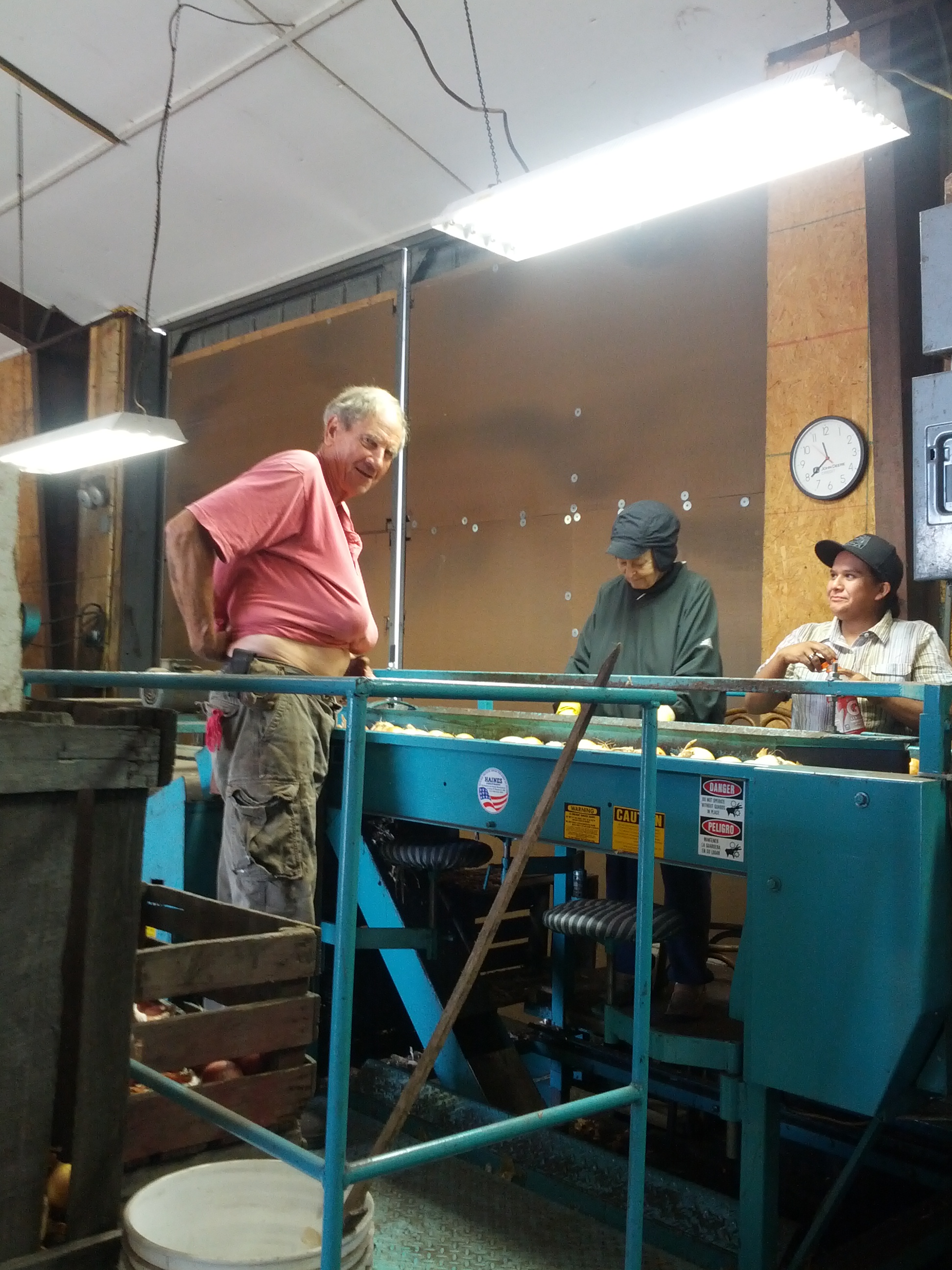
Kickstarter campaign update!

http://www.kickstarter.com/projects/1176629437/muckville-a-memoir-of-the-public-policy-life-of-a-0

It’s the weekend and we are still moving forward. As of noon on Sunday I now have 23 backers and have reached 17% of my funding goal.

So, we are continuing to move forward but this is a huge weekend and week coming up!

A special shout out to all of my public policy and media/news friends. many of you are mentioned in the memoir! Very positively, for the most part, I might add. Hey, I’m just telling the truth as to what Eve and I have experienced over the years and so many of you have played a part in helping us help our community, either via your actions in your positions or via accurately telling our story and helping us get the word out!

Thanks again to all of you that have backed me so far and have spread the word! I greatly appreciate it. Just like years ago I just knew we would be successful in obtaining the eventual special earmark we obtained as part of the 2002 Farm Bill I see myself some day, in the very near future, talking about “Muckville” and sharing how others can imitate what we did in terms of grassroots activism!

This piece details just some of our public policy activities!

http://digital.turn-page.com/i/102943/3

This story deals with the 1 year anniversary of Irene, which really details what we have been struggling with:

And here is a story about Irene at the time:

Again, thank you all!!!!!

My prologue …

Back in September I posted my prologue and the note from Eve. Since I am in the midst of this Kickstarter campaign I think I should post them again. Sort of explains my book and why this project should matter to you:

PROLOGUE

Muckville.  I can see you asking yourself now

Why should I care about a book about farming? Or one about public policy advocacy and dealing with the media? Or a about a book that combines the realities of farming with agriculture-specific policy, advocacy and dealing with the media?

We all have to eat. Every day if possible. Day after day. Until we die we have to eat. Food, along with breathable air, clean water and adequate shelter is one of our most basic needs. Since there are roughly 3.3 million farmers in the U.S. comprising roughly 2% of the general population, odds are you have never met a farmer. Despite the growth in popularity of Community Supported Agriculture (CSA) and local farmers’ markets it is most likely you have never met, spoken, smelled or touched a farmer.  Or set foot on a farm.

Though the United States was once a primarily an agricultural society and even as recently as the turn of the previous century roughly 40% of the population farmed, since then, and especially since the advancements associated with Norman Borlaug’s “Green Revolution” fewer and fewer farmers on less and less land space have produced one of the world’s safest, most abundant and cheapest food supplies.

And with that change has come an incredible level of disconnect between the people who primarily produce our food and the citizens who eat it. Sadly, when you mention the word farmer the first image that will pop into someone’s head will be Eddie Albert’s character Oliver Wendell Douglas from the CBS sitcom “Green Acres.” Or worse, some character from one of the various reality TV shows that keep popping up, and frequently aren’t so real.

Though farmers’ markets are exploding across the country and thanks to the foodie movement there is a strong renewed interest in agriculture, much of the information about farmers is not coming from us. Food critics and chefs will frequently pontificate about farming, and though some of them may have a small hobby farm, for the most part they are not farmers. They do not know what it is like, on a day to day basis, to be a farmer in the 21st century.

I simply don’t have enough heads for all the hats I have to wear. I have to be a soil scientist, a chemist, a financial planner, an accountant, a bookkeeper, a regulator, a marketer and frequently a public relations person and public policy advocate.

Farming today is governed by a myriad of laws and regulations that cover numerous aspects of our business on multiple levels. And there are so many groups, organizations and pressures out there trying to influence or change those laws and regulations on a seemingly daily basis.

In the mid 1990’s after leaving the farm a short time to pursue my graduate degree and after I married my wonderful wife Eve, I returned to the family onion farm. My brother and I are the fourth generation of the same family on a farm that started in the U.S. at the turn of the 20th century. As soon as I returned I started dealing with a variety of issues and crises, including weather disasters and various labor advocacy organizations. I was baptized by fire. Eve and I had to learn, for the most part on our own, how to fight for our farm and our industry. It wasn’t easy at first (for the most part it still isn’t now, 17 years later).  But, trial by fire typically isn’t.

So why is this all important to you? Because as I said, we all have to eat. It’s one of our most fundamental needs. You should know something about how your food is produced. Not from sitcoms, or from food critics or from chefs, no matter how well intentioned they may be.  You should know from one of us who produces it.

Now, there are some books out there written by farmers about farming. Many of those books are about the adventures of people who eschew urban or suburban life to move to the country and take up farming. They extol the benefits of a more simple life.

That’s not the point of this book.

Life is not simple, nor, quite frequently, very fair. A hailstorm that decimates your crop mid season or a hurricane caused flood that wipes virtually your entire crop away is not fair. And how you deal with those scenarios is anything but simple. I’ve dealt with those situations, sadly, more than once. I’ve also dealt with very stupid government programs and terrible proposed legislation. And over the years my wife and I have had a fair number of successes in dealing with such situations. That’s what this book details.

Though it is a memoir about my specific experiences on the farm and in front of a camera or on Capitol Hill, what I relate, the techniques and the tricks and methods of dealing with the media or developing grassroot strategies to fight for a given issue can be applied by you. No matter what you do, or where you live, or what problem you may be facing, my example can provide you with a roadmap to how you can successfully fight for your cause.

The system is messed up. It sucks, to  be quite frank. But my specific experiences show that if you are persistent and you have a fraction of a clue as to what to do, you can make a positive change for your community, too.

Why should you read this book? Because I need better informed end users of my product. I need you to understand why after a devastating hailstorm or flood I need your support and help. I need you to have a better connection with the people who produce the food you eat.  And, you need to better understand the people who grow your food, and how the policy decisions can affect every aspect of the food you eat.

Why should you read this book? Just as important as learning about how your food is grown, I want you to read it and to realize that you can get off the couch and fight for your family and your community. Though the deck is stacked against you, like it is against me, you can still effect a positive change. All is not bleak. There is hope.

I  want you to read this book so that the next time you walk into the produce section of your local supermarket you will pause for a moment and just think about what was involved to get those fresh vegetables and fruits on that shelf.

A NOTE FROM EVE

Muckville. That’s where we live, both literally and figuratively.

And every day something weird is happening on this farm. In the early years I kept waiting for it to end, waiting for calm. After 20 years I now realize that for better or worse, that’s just not going to happen.  Part of it has to do with who I married. I think he described it best one night when we were talking about how people react to adversity. He said, “People basically fall into one of two categories: sheep or wolf. And I’m not a sheep.” I think I am a sheep who hitched a ride with a wolf. When we lost our crop to hail the first time in 1996 and our insurance turned out to be worthless and I was pregnant and large amounts of debt loomed on the horizon, I was perfectly willing to throw up my hands, quit and go do something else. In that respect I think I am like most people. Life is just easier if you can go along with the flow and avoid the pitfalls.  But if everyone did that improvements would seldom if ever be made.

If I’ve surmised anything over the years, it’s that problems come about seemingly on their own resulting from a convergence of factors: a misinterpretation of a law or regulation, a quirky personality, a do-gooder who is just plain wrong, and/or a bureaucrat who refuses to do anything other than “the way it’s always been done.” The result is that change takes a lot of work but more importantly perseverance.

So what do you need to make a change? The first quality just about everyone has. It equates to “What the @#$% happened here?” The second quality many people have, “I’m mad. I’m going to complain to the proper authorities, and this will be fixed!” But there are a lot of problems out there and it is just as likely that your problem won’t be fixed. Sure some may complain for a while but at some point most people simply cut their losses and walk away grumbling. If you are really determined to make a change, it takes more than complaining. Change comes about because you can articulate exactly what is wrong and why, AND you have mapped out and researched what should be done instead. Only then do you have a chance.

Chris (God bless him) has chronicled several things we have fought to change. Some of it is humorous. a lot of it comes under “You just can’t make that up!” and parts of it I simply cannot read because it was enough for me to live through it. We hope that you will be entertained and learn a little about production agriculture along the way. But what we really hope is that maybe the next time you see a problem, you will have the courage to be a wolf.
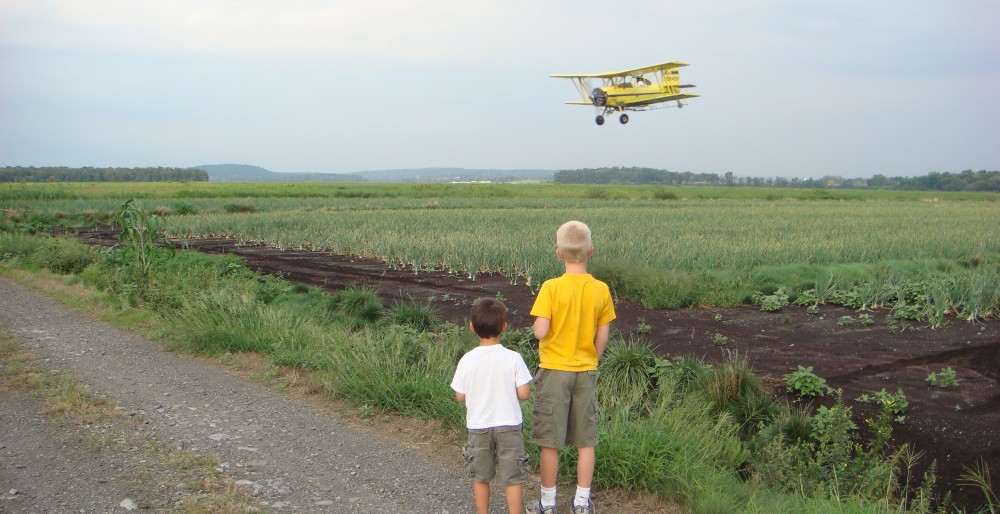
How wonderful is my wife? Check out this video from back in 2001 when she called in to C-Span to talk about the Farm Bill and how vegetables and fruits are typically short-changed when it comes to federal agriculture policy:

New Muckville Kickstarter Update!

http://www.kickstarter.com/projects/1176629437/muckville-a-memoir-of-the-public-policy-life-of-a-0

Great news … up to 21 backers and roughly 14% of goal. And so many of you have said you will back soon and are spreading the word!

Once again I can’t thank you all enough! Let’s keep it going!

Kickstarter Daily Update!

Image

(see note about image below)


NEW BACKERS!

Okay, here it is, we are now at 19 backers, $717, 13% of goal!

You guys are awesome!!!!!

Many more have told me they will soon back and be spreading the word.

I know these posts suck but you have the power to stop me from doing them … by helping me reach goal!

http://www.kickstarter.com/projects/1176629437/muckville-a-memoir-of-the-public-policy-life-of-a-0


* image note: I wanted to post a “happy face” and believe it or not that is Christopher Walken’s “happy face.”

The McTrip from Hell

The following is another excerpt from my yet unpublished memoir, “Muckville: Farm Policy, Media and the Strange Oddities of Semi-Rural Life.”

Image

The McTrip from Hell

In late February of 2010 I had a 3 day trip down to Washington, D.C. and Capitol Hill. Because of an approaching blizzard I canceled my meetings for the final day and I switched from a 4 p.m. train to the 9 a.m. Acela, so as to maybe beat the snow and get home ahead of the blizzard. So far so good. About halfway home, just outside of Philadelphia we came to an abrupt stop. Yes, we stopped. This was a first for me, after taking the Amtrak train back and forth over the last three years or so.

After 10 minutes we started moving … backwards. The conductor then announced that someone was hit, a “trespasser” was the term she used, on the tracks. Not by us but by a southbound train. So we had to go back to a junction and switch tracks. And then eventually we would go forward again. But first we sat a half hour or so … and it started to snow heavily … tick tock, tick tock.

The conductors on our train were not exactly forthcoming with information so I called Eve on my cell and asked her to find out what the hell was going on. Eve called Amtrak and found out not one but two dummies were hit by the southbound train. Two young girls, 10th  graders or so, who decided to skip out of school and walk on the train tracks to get to wherever they were skipping to. He said to Eve “we can’t travel anywhere near the speed we’d like to because of stuff like this that happens.”

Hmm … one wonders how often “stuff like this” does happen? He told Eve there are now five  or six trains, not sure if he meant all were northbounds, were sitting and waiting until the tracks are cleared by law enforcement. Because now it was a crime scene, thanks to the two young “Darwin Award” winners, though I wasn’t sure at that point if they had died or not. I know that sounds cruel, but why would anyone walk on train tracks for a very active, commuter train line?

After close to an hour we were finally on the move forward. We were on restricted speed for 3 miles then we finally made it to the Philadelphia station. I asked Eve if the two girls had died and she said “what do you think?”

Finally, a couple of hours late, I made it to Penn Station in NYC. I then hopped on a connecting train to the new facility at Secaucus Junction. But, thanks to the delays, I missed all of the early Metro North trains from Secaucus Junction to my stop in Harriman, New York. So I called my parents and told them I would be getting there late, probably close to 6:00pm. My parents agreed earlier to pick me up, because Eve had to stay home and watch the boys. My dad said to me when I called him to tell him when I thought I would get to Harriman, “it’s a blizzard, you know.” I replied, “I know, take my Eddie Bauer Ford Explorer, it’s got 4 wheel drive.”

When my train finally arrived in Harriman it was a full blown blizzard. The roads were heavily covered with snow. I had gotten on a 9:00 a.m. train and now it was 5:30 p.m. and snowing like crazy.

In normal conditions, at least a 30 minute drive from home. But, this wasn’t normal driving conditions. I’m not talking about the snow, I’m talking about my ride with my parents.

My parents were all set on eating at Wendy’s on the way home.  White out conditions, a foot and a half of snow with more falling but we must stop. Well, when we pulled into the Wendy’s in Chester, it was closed. My mom said “how strange.” I replied, “what are you, Nanook of the North? It’s insane to expect them to be open.” My mom said in reply, “I suppose.” But then she stretches her neck and exclaims,  “Hey McDonald’s down the road looks open.” And off to McDonald’s we went.

Did I mention it was a blizzard?

Yes, we must stop and eat at the McDonald’s in Chester. We are the only lunatics there and they are closing once we leave. As we stop at the napkin and condiment island my dad says, in his best conspiratorial voice, “you know these cups for ketchup are smaller here than at Wendy’s” “I did not know that” I replied We sit and eat as quickly as possible, though my dad isn’t eating quick enough for my mom’s liking. “Look at him” she snarls, “eating one French fry at a time. HURRY UP!” she demands. I thought she was going to throw one of her French fries at him. Then she said to me “wait till he starts picking his teeth with his straw.” My dad got the hint from mom and quickened the pace and soon we were crawling on the back roads to home. If I died on the way home at least I would have had one last dining McExperience.

This entire fiasco was chronicled, live, on Facebook. As I posted after we left McDonald’s:

“UPDATE: we are sitting stuck on the Florida-Chester road. I’m stuck with two lunatics. We have no idea why traffic isn’t moving but at least we ate our f*#+ing Happy Meal at McDonalds. You cannot make this sh#t up.”

I then looked at the dash and I saw we had less than a quarter tank of gas. The possibility now loomed we could run out of gas on the way home. I posted on Facebook: “I will be impaling myself with my straw if we don’t start moving soon.”

After about 20 minutes we were finally on the move. But the bad news, my parents started fighting. Or, my mom was fighting and my dad was taking a verbal walloping. I wish I could share it all but it was far too much material for me to chronicle. I literally couldn’t keep up. And it must have been 150 degrees in the truck. I wanted to bail out or be put out of my misery.

Once we were about two to three miles from home I texted Eve to have the bourbon ready.

At about 9:00 p.m. I finally arrived home, 12 hours after I had left Washington, DC. Truly a trip from Hell.

Image

New pitch for my unpublished book

This post is for all of my new Twitter and blog followers (sorry for the repetition to my longtime followers).

Back in the winter I wrote a book about my wonderful wife Eve’s life on the farm and our media and public policy work. The title of the book is:

“Muckville: Farm Policy, Media and the Strange Oddities of Semi-Rural Life”

I have an editor but I am looking for a publisher. It’s an odd sort of book that doesn’t fit neatly in any real sort of category. It’s about farming and the strange stuff we deal with but mainly about our struggles in dealing with government and trying to change things from the ground level.

This link covers some of that policy work:

http://digital.turn-page.com/i/102943/3

If you happen to know anyone that might be interested in such a work please feel free to pass my info along. I will give you lots and lots of onions!

Below is prologue and a word from Eve:

PROLOGUE


Muckville.  I can see you asking yourself now

Why should I care about a book about farming? Or one about public policy advocacy and dealing with the media? Or a about a book that combines the realities of farming with agriculture-specific policy, advocacy and dealing with the media?

We all have to eat. Every day if possible. Day after day. Until we die we have to eat. Food, along with breathable air, clean water and adequate shelter is one of our most basic needs. Since there are roughly 3.3 million farmers in the U.S. comprising roughly 2% of the general population, odds are you have never met a farmer. Despite the growth in popularity of Community Supported Agriculture (CSA) and local farmers’ markets it is most likely you have never met, spoken, smelled or touched a farmer.  Or set foot on a farm.

Though the United States was once a primarily an agricultural society and even as recently as the turn of the previous century roughly 40% of the population farmed, since then, and especially since the advancements associated with Norman Borlaug’s “Green Revolution” fewer and fewer farmers on less and less land space have produced one of the world’s safest, most abundant and cheapest food supplies.

And with that change has come an incredible level of disconnect between the people who primarily produce our food and the citizens who eat it. Sadly, when you mention the word farmer the first image that will pop into someone’s head will be Eddie Albert’s character Oliver Wendell Douglas from the CBS sitcom “Green Acres.” Or worse, some character from one of the various reality TV shows that keep popping up, and frequently aren’t so real.

Though farmers’ markets are exploding across the country and thanks to the foodie movement there is a strong renewed interest in agriculture, much of the information about farmers is not coming from us. Food critics and chefs will frequently pontificate about farming, and though some of them may have a small hobby farm, for the most part they are not farmers. They do not know what it is like, on a day to day basis, to be a farmer in the 21st century.

I simply don’t have enough heads for all the hats I have to wear. I have to be a soil scientist, a chemist, a financial planner, an accountant, a bookkeeper, a regulator, a marketer and frequently a public relations person and public policy advocate.

Farming today is governed by a myriad of laws and regulations that cover numerous aspects of our business on multiple levels. And there are so many groups, organizations and pressures out there trying to influence or change those laws and regulations on a seemingly daily basis.

In the mid 1990’s after leaving the farm a short time to pursue my graduate degree and after I married my wonderful wife Eve, I returned to the family onion farm. My brother and I are the fourth generation of the same family on a farm that started in the U.S. at the turn of the 20th century. As soon as I returned I started dealing with a variety of issues and crises, including weather disasters and various labor advocacy organizations. I was baptized by fire. Eve and I had to learn, for the most part on our own, how to fight for our farm and our industry. It wasn’t easy at first (for the most part it still isn’t now, 17 years later).  But, trial by fire typically isn’t.

So why is this all important to you? Because as I said, we all have to eat. It’s one of our most fundamental needs. You should know something about how your food is produced. Not from sitcoms, or from food critics or from chefs, no matter how well intentioned they may be.  You should know from one of us who produces it.

Now, there are some books out there written by farmers about farming. Many of those books are about the adventures of people who eschew urban or suburban life to move to the country and take up farming. They extol the benefits of a more simple life.

That’s not the point of this book.

Life is not simple, nor, quite frequently, very fair. A hailstorm that decimates your crop mid season or a hurricane caused flood that wipes virtually your entire crop away is not fair. And how you deal with those scenarios is anything but simple. I’ve dealt with those situations, sadly, more than once. I’ve also dealt with very stupid government programs and terrible proposed legislation. And over the years my wife and I have had a fair number of successes in dealing with such situations. That’s what this book details.

Though it is a memoir about my specific experiences on the farm and in front of a camera or on Capitol Hill, what I relate, the techniques and the tricks and methods of dealing with the media or developing grassroot strategies to fight for a given issue can be applied by you. No matter what you do, or where you live, or what problem you may be facing, my example can provide you with a roadmap to how you can successfully fight for your cause.

The system is messed up. It sucks, to  be quite frank. But my specific experiences show that if you are persistent and you have a fraction of a clue as to what to do, you can make a positive change for your community, too.

Why should you read this book? Because I need better informed end users of my product. I need you to understand why after a devastating hailstorm or flood I need your support and help. I need you to have a better connection with the people who produce the food you eat.  And, you need to better understand the people who grow your food, and how the policy decisions can affect every aspect of the food you eat.

Why should you read this book? Just as important as learning about how your food is grown, I want you to read it and to realize that you can get off the couch and fight for your family and your community. Though the deck is stacked against you, like it is against me, you can still effect a positive change. All is not bleak. There is hope.

I  want you to read this book so that the next time you walk into the produce section of your local supermarket you will pause for a moment and just think about what was involved to get those fresh vegetables and fruits on that shelf.


A NOTE FROM EVE

Muckville. That’s where we live, both literally and figuratively.

And every day something weird is happening on this farm. In the early years I kept waiting for it to end, waiting for calm. After 20 years I now realize that for better or worse, that’s just not going to happen.  Part of it has to do with who I married. I think he described it best one night when we were talking about how people react to adversity. He said, “People basically fall into one of two categories: sheep or wolf. And I’m not a sheep.” I think I am a sheep who hitched a ride with a wolf. When we lost our crop to hail the first time in 1996 and our insurance turned out to be worthless and I was pregnant and large amounts of debt loomed on the horizon, I was perfectly willing to throw up my hands, quit and go do something else. In that respect I think I am like most people. Life is just easier if you can go along with the flow and avoid the pitfalls.  But if everyone did that improvements would seldom if ever be made.

If I’ve surmised anything over the years, it’s that problems come about seemingly on their own resulting from a convergence of factors: a misinterpretation of a law or regulation, a quirky personality, a do-gooder who is just plain wrong, and/or a bureaucrat who refuses to do anything other than “the way it’s always been done.” The result is that change takes a lot of work but more importantly perseverance.

So what do you need to make a change? The first quality just about everyone has. It equates to “What the @#$% happened here?” The second quality many people have, “I’m mad. I’m going to complain to the proper authorities, and this will be fixed!” But there are a lot of problems out there and it is just as likely that your problem won’t be fixed. Sure some may complain for a while but at some point most people simply cut their losses and walk away grumbling. If you are really determined to make a change, it takes more than complaining. Change comes about because you can articulate exactly what is wrong and why, AND you have mapped out and researched what should be done instead. Only then do you have a chance. 

Chris (God bless him) has chronicled several things we have fought to change. Some of it is humorous. a lot of it comes under “You just can’t make that up!” and parts of it I simply cannot read because it was enough for me to live through it. We hope that you will be entertained and learn a little about production agriculture along the way. But what we really hope is that maybe the next time you see a problem, you will have the courage to be a wolf. 
The non public policy/legislative highlights of my recent DC trip!

First off, I wish I have pictures of what i am about to relate, but alas, I do not.

The following are the two best events that took place that did not involve advocacy or legislative visits or events on Capitol Hill during my recent trip.

Event #1

As I was sitting in my seat, in business class on Amtrak’s 8:00am northeast regional train to DC a man with a foreign heritage (maybe from India, or Pakistan) sat down next to me. He had a very colorful scarf on his head. It was red and orange. And it was wrapped in an elaborate fashion. As he sat down he proceeded to remove the scarf and he promptly blew his nose into it. Within moments the conductor appeared, examined his ticket, and informed him he did not have a business class seat and he would have to move.

Since he promptly moved I do not know if he put the scarf back on his head.

Event #2

As I was exiting a 5th floor men’s room in the Longworth House Office Building on Tuesday I proceeded to pass a man of entered with a half eaten banana in his hand, which he was still eating. He entered a men’s stall.

That’s just weird. Of course it would have been far weirder if he instead exited a men’s stall with a half eaten banana in his hand.

You simply cannot make this stuff up.

About my book project and search for a publisher …

You may not have noticed but I have an “About My Book” page on my blog. If you haven’t the text for it is below. It is what I wrote to describe it for my failed Kickstarter project (I did that at the wrong time).

Since I wrote it I now have a fantastic editor, Penny Steyer, who has actually read the entire 100K word draft and made a number of initial edits. Eve and I are going over it and will be meeting with her shortly to move forward.

But, we still are looking for a publisher. It is an odd book in that it doesn’t fit certain or typical farming related topics. For example, the newbie who lives in the city and moves to the country and becomes a farmer. My book is about both conventional farming as well as the nuts and bolts details of dealing with the legislative process, working with the media and accomplishing really good from the grassroots or ground level.

A lot of people complain about the system, but how many understand how it works, and how you can actually accomplish good? My book details that. It’s funny, sometimes irreverent, and mostly entertaining and informative. I wrote it with the idea of it becoming eventually a film or tv project. I think it has that potential.

So, if you are a publisher looking to take a chance on something just a wee bit different but very provocative and entertaining … well, you know how to reach me!

Here is a link to an excellent local news piece that talked about my project:

http://chroniclenewspaper.com/apps/pbcs.dll/article?AID=/20130404/NEWS01/130409992/Chris-Pawelski-stirs-the-muck

Here is the description found on my “About My Book” page:

I’ve written a memoir about my experiences on our 4th generation family onion farm and my very active volunteer public policy/advocacy experiences over the years (http://bit.ly/SGwZb8). I’m an outstanding researcher, a fantastic first draft writer but not a very good editor. My wife typically edits my work but this memoir is just too long (over 106K words) and personally too painful for her to tackle. Remember “The Farmer’s Wife” documentary that ran on PBS a few years ago (http://to.pbs.org/aUdsi)? The shared experiences and similar pain made it too hard for my wife to watch (see: http://bit.ly/WcHTrM). So, since my memoir details some painful memories my wife can’t do it. I need to hire an editor and being over $250K in the hole makes hiring an editor impossible without help (http://bit.ly/wpxL5z).

Once my first draft is edited it will be far more likely a book publisher or a literary agent will take it on. Now, obviously there are no guarantees that it will be published, but, I can assure you I’m a very good writer and I have had numerous unique experiences over the years, including securing a $10 million dollar special earmark that was part of the 2002 Farm Bill, testifying before the U.S. Senate Agriculture Committee, meeting and working with dozens of elected officials, including former Senator Hillary Clinton, Vice President Al Gore, current Senators Kirsten Gillibrand and Charles Schumer, amongst many others. I’ve also appeared in the media hundreds of times over the years, from the national press like CNN and the CBS Evening News and the NY Times to various trade publications and local press, to recently The Hindu and the BBC. I’ve even been quoted in Vogue (http://bit.ly/OqeFeJ). Now, come on, how many farmers do you know quoted in Vogue? Just google my name to see how often I’ve appeared in the media.

Secretary of Agriculture Tom Vilsack, in a speech delivered back in December of 2012, said:

“It isn’t just the differences of policy. It’s the fact that rural America with a shrinking population is becoming less and less relevant to the politics of this country, and we had better recognize that and we better begin to reverse it.” http://yhoo.it/VTM2fJ

I think he’s dead wrong, and it is exactly the opposite of what I relate in my book. We in rural America have been and continue to be relevant.

And my book is a positive story, because if you watch the cable talk shows and read people like Matt Taibbi (who I like very much) you walk away with the impression that the average citizen like you and I can never cause positive change, not without spending a lot of money. Well, no one has ever paid me, I have never donated anything to any politician. Not once have we ever been asked to do a fund raiser or donate, or even vote for the public official we work with. Hard to believe, but true. My story is in the end a positive, uplifting narrative.

Further, farmers and farming stories are really under-represented in the general media. I explain what is involved to grow and sell an onion, and how much, or rather, how little we make. It’s an inside story, one that chain stores don’t want the average consumer to know. I want to tell that story, to an even wider audience, hence why I have written the book and look to make it a commercial success.

I have a story that needs to be told. I’ve done the hard part in terms of the research and writing the first draft. That’s done. I’m almost to the finish line. Can you help me cross it by helping me edit and complete the work, making it more marketable to a literary agent or publishing house?

Share this: