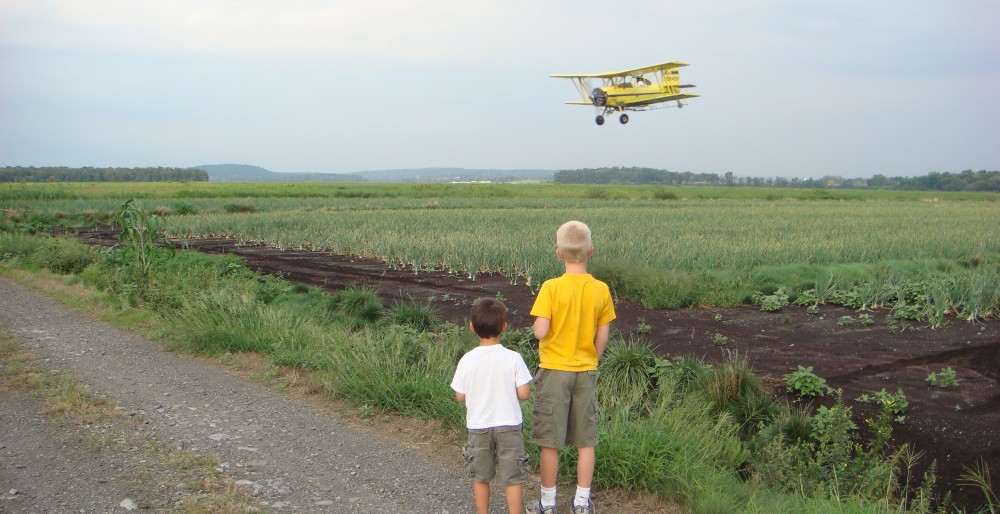
New pitch for my unpublished book

This post is for all of my new Twitter and blog followers (sorry for the repetition to my longtime followers).

Back in the winter I wrote a book about my wonderful wife Eve’s life on the farm and our media and public policy work. The title of the book is:

“Muckville: Farm Policy, Media and the Strange Oddities of Semi-Rural Life”

I have an editor but I am looking for a publisher. It’s an odd sort of book that doesn’t fit neatly in any real sort of category. It’s about farming and the strange stuff we deal with but mainly about our struggles in dealing with government and trying to change things from the ground level.

This link covers some of that policy work:

http://digital.turn-page.com/i/102943/3

If you happen to know anyone that might be interested in such a work please feel free to pass my info along. I will give you lots and lots of onions!

Below is prologue and a word from Eve:

PROLOGUE


Muckville.  I can see you asking yourself now

Why should I care about a book about farming? Or one about public policy advocacy and dealing with the media? Or a about a book that combines the realities of farming with agriculture-specific policy, advocacy and dealing with the media?

We all have to eat. Every day if possible. Day after day. Until we die we have to eat. Food, along with breathable air, clean water and adequate shelter is one of our most basic needs. Since there are roughly 3.3 million farmers in the U.S. comprising roughly 2% of the general population, odds are you have never met a farmer. Despite the growth in popularity of Community Supported Agriculture (CSA) and local farmers’ markets it is most likely you have never met, spoken, smelled or touched a farmer.  Or set foot on a farm.

Though the United States was once a primarily an agricultural society and even as recently as the turn of the previous century roughly 40% of the population farmed, since then, and especially since the advancements associated with Norman Borlaug’s “Green Revolution” fewer and fewer farmers on less and less land space have produced one of the world’s safest, most abundant and cheapest food supplies.

And with that change has come an incredible level of disconnect between the people who primarily produce our food and the citizens who eat it. Sadly, when you mention the word farmer the first image that will pop into someone’s head will be Eddie Albert’s character Oliver Wendell Douglas from the CBS sitcom “Green Acres.” Or worse, some character from one of the various reality TV shows that keep popping up, and frequently aren’t so real.

Though farmers’ markets are exploding across the country and thanks to the foodie movement there is a strong renewed interest in agriculture, much of the information about farmers is not coming from us. Food critics and chefs will frequently pontificate about farming, and though some of them may have a small hobby farm, for the most part they are not farmers. They do not know what it is like, on a day to day basis, to be a farmer in the 21st century.

I simply don’t have enough heads for all the hats I have to wear. I have to be a soil scientist, a chemist, a financial planner, an accountant, a bookkeeper, a regulator, a marketer and frequently a public relations person and public policy advocate.

Farming today is governed by a myriad of laws and regulations that cover numerous aspects of our business on multiple levels. And there are so many groups, organizations and pressures out there trying to influence or change those laws and regulations on a seemingly daily basis.

In the mid 1990’s after leaving the farm a short time to pursue my graduate degree and after I married my wonderful wife Eve, I returned to the family onion farm. My brother and I are the fourth generation of the same family on a farm that started in the U.S. at the turn of the 20th century. As soon as I returned I started dealing with a variety of issues and crises, including weather disasters and various labor advocacy organizations. I was baptized by fire. Eve and I had to learn, for the most part on our own, how to fight for our farm and our industry. It wasn’t easy at first (for the most part it still isn’t now, 17 years later).  But, trial by fire typically isn’t.

So why is this all important to you? Because as I said, we all have to eat. It’s one of our most fundamental needs. You should know something about how your food is produced. Not from sitcoms, or from food critics or from chefs, no matter how well intentioned they may be.  You should know from one of us who produces it.

Now, there are some books out there written by farmers about farming. Many of those books are about the adventures of people who eschew urban or suburban life to move to the country and take up farming. They extol the benefits of a more simple life.

That’s not the point of this book.

Life is not simple, nor, quite frequently, very fair. A hailstorm that decimates your crop mid season or a hurricane caused flood that wipes virtually your entire crop away is not fair. And how you deal with those scenarios is anything but simple. I’ve dealt with those situations, sadly, more than once. I’ve also dealt with very stupid government programs and terrible proposed legislation. And over the years my wife and I have had a fair number of successes in dealing with such situations. That’s what this book details.

Though it is a memoir about my specific experiences on the farm and in front of a camera or on Capitol Hill, what I relate, the techniques and the tricks and methods of dealing with the media or developing grassroot strategies to fight for a given issue can be applied by you. No matter what you do, or where you live, or what problem you may be facing, my example can provide you with a roadmap to how you can successfully fight for your cause.

The system is messed up. It sucks, to  be quite frank. But my specific experiences show that if you are persistent and you have a fraction of a clue as to what to do, you can make a positive change for your community, too.

Why should you read this book? Because I need better informed end users of my product. I need you to understand why after a devastating hailstorm or flood I need your support and help. I need you to have a better connection with the people who produce the food you eat.  And, you need to better understand the people who grow your food, and how the policy decisions can affect every aspect of the food you eat.

Why should you read this book? Just as important as learning about how your food is grown, I want you to read it and to realize that you can get off the couch and fight for your family and your community. Though the deck is stacked against you, like it is against me, you can still effect a positive change. All is not bleak. There is hope.

I  want you to read this book so that the next time you walk into the produce section of your local supermarket you will pause for a moment and just think about what was involved to get those fresh vegetables and fruits on that shelf.


A NOTE FROM EVE

Muckville. That’s where we live, both literally and figuratively.

And every day something weird is happening on this farm. In the early years I kept waiting for it to end, waiting for calm. After 20 years I now realize that for better or worse, that’s just not going to happen.  Part of it has to do with who I married. I think he described it best one night when we were talking about how people react to adversity. He said, “People basically fall into one of two categories: sheep or wolf. And I’m not a sheep.” I think I am a sheep who hitched a ride with a wolf. When we lost our crop to hail the first time in 1996 and our insurance turned out to be worthless and I was pregnant and large amounts of debt loomed on the horizon, I was perfectly willing to throw up my hands, quit and go do something else. In that respect I think I am like most people. Life is just easier if you can go along with the flow and avoid the pitfalls.  But if everyone did that improvements would seldom if ever be made.

If I’ve surmised anything over the years, it’s that problems come about seemingly on their own resulting from a convergence of factors: a misinterpretation of a law or regulation, a quirky personality, a do-gooder who is just plain wrong, and/or a bureaucrat who refuses to do anything other than “the way it’s always been done.” The result is that change takes a lot of work but more importantly perseverance.

So what do you need to make a change? The first quality just about everyone has. It equates to “What the @#$% happened here?” The second quality many people have, “I’m mad. I’m going to complain to the proper authorities, and this will be fixed!” But there are a lot of problems out there and it is just as likely that your problem won’t be fixed. Sure some may complain for a while but at some point most people simply cut their losses and walk away grumbling. If you are really determined to make a change, it takes more than complaining. Change comes about because you can articulate exactly what is wrong and why, AND you have mapped out and researched what should be done instead. Only then do you have a chance. 

Chris (God bless him) has chronicled several things we have fought to change. Some of it is humorous. a lot of it comes under “You just can’t make that up!” and parts of it I simply cannot read because it was enough for me to live through it. We hope that you will be entertained and learn a little about production agriculture along the way. But what we really hope is that maybe the next time you see a problem, you will have the courage to be a wolf. 
Man vs. Squirrel

Image

The following is another excerpt from my yet unpublished memoir, “Muckville: Farm Policy, Media and the Strange Oddities of Semi-Rural Life.” It involves one man’s war against squirrels in order to keep his nuts.

Man vs. Squirrel

Where we live is a very rural area, with thousands of acres of wide- open farmland. We have some wooded areas and small mountains nearby, but not within a mile or two from my house and the barns where we pack our onions, which are on the same property as my house. What this translates into is essentially a low squirrel population zone. Squirrels you see in the woods, or in a suburban neighborhood. We simply are not that. But, on occasion, every so often, a squirrel or three will venture out to our area. They must be forward scouts or something. You’ll see them in the trees or running around for a few days. Then eventually you’ll find them on the side of the road, dead, roadkill.

Set within that context allow me to present one example of the eternal battle waged between MAN and NATURE. I proudly present this microcosm of the struggle … Polish walnut lover vs. the squirrels!

My brother lives outside the Village of Montgomery, about 30 minutes from my house and the barns. He has 4 walnut trees in his yard and my dad back in September of 2010 had him collect a bunch of the nuts that had fallen from the tree to bring to him at the barn. Did I mention that my dad loves walnuts? For those of you not familiar with walnuts, Wiki points out:

“Walnuts are rounded, single-seeded stone fruits of the walnut tree. The walnut fruit is enclosed in a green, leathery, fleshy husk. This husk is inedible. After harvest, the removal of the husk reveals the wrinkly walnut shell, which is in two halves.”

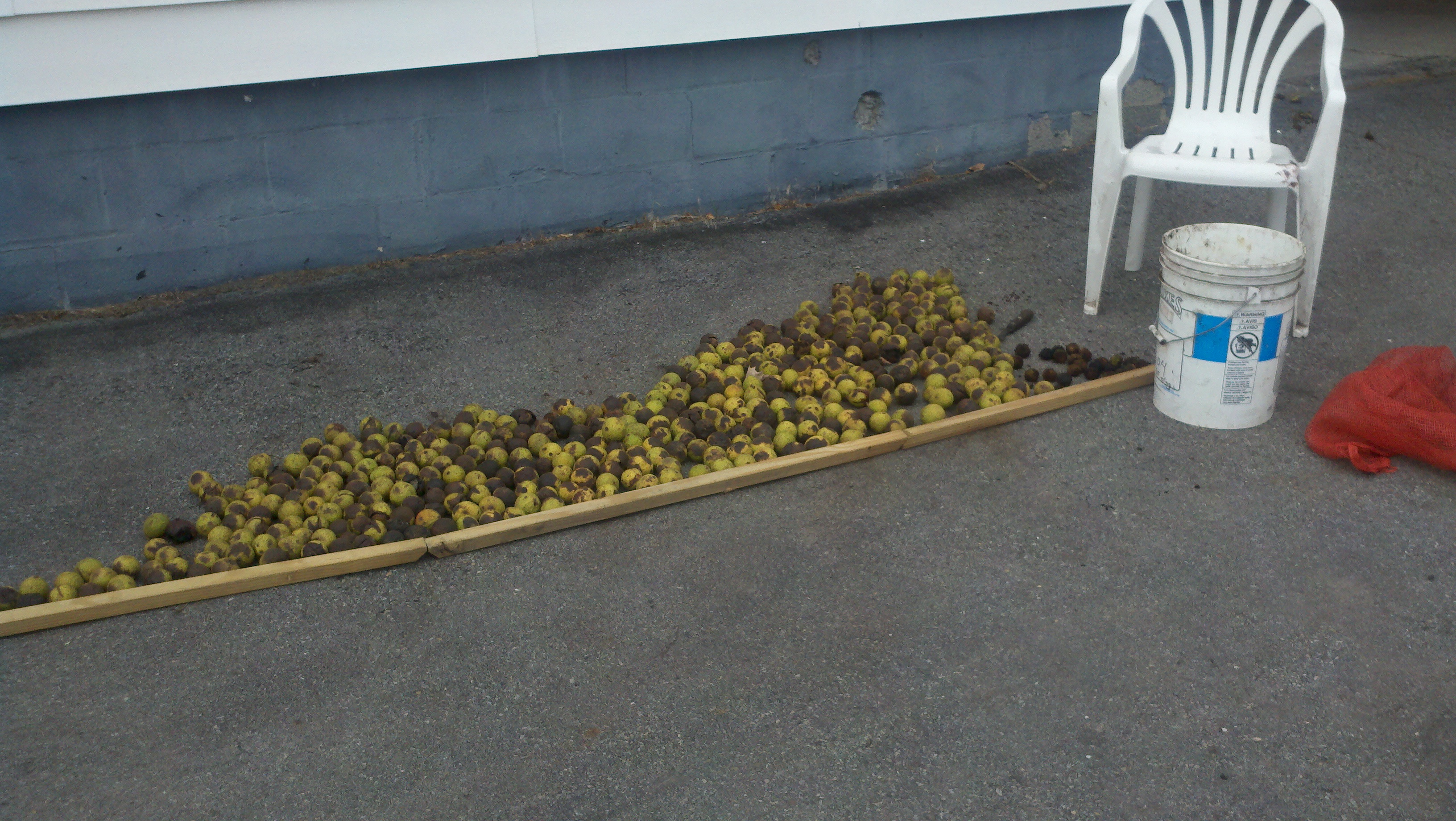
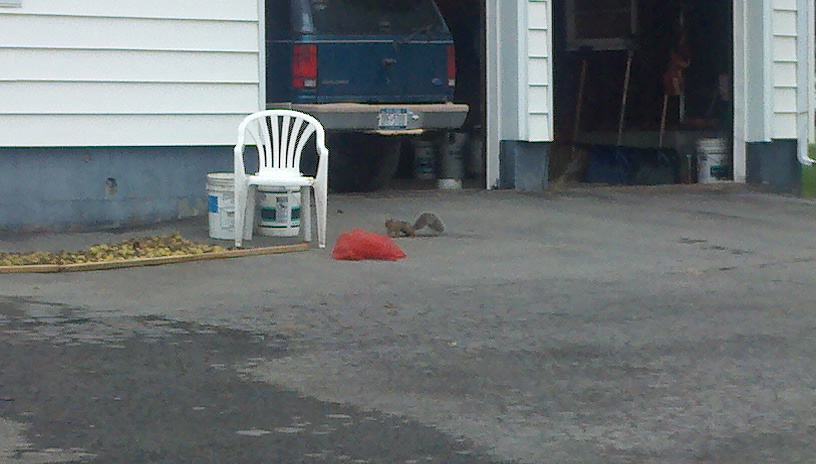
My dad early that morning separated most of the walnuts from their green outer shell, which took some time and effort, and then decided to lay them out to dry out on my blacktop in front of my house. It took him about an hour to separate the nut from the outer green goo casing. He so loves these black walnuts. Where he laid them out was clearly visible from the barn where we were working, and since it was warm and dry we had the barn doors open. As I would feed the grader with onions and take away the stacked pallets I would occasionally catch a glance of my dad’s walnuts on the ground.

Image

He had two distinct piles, those shelled and those still with the green outer casing.

As we were grading, around mid morning, I brought in some boxes of onions from outside into the barn and I noticed a flash of gray. It was a squirrel. It was making a dash for the pile of booty. And then I blinked and there was another one, heading towards the walnuts. As I watched, doubling over in laughter, the two squirrels started taking all of the nuts my dad had separated from the casing this morning. They were in heaven; they had found a veritable walnut goldmine.

Image

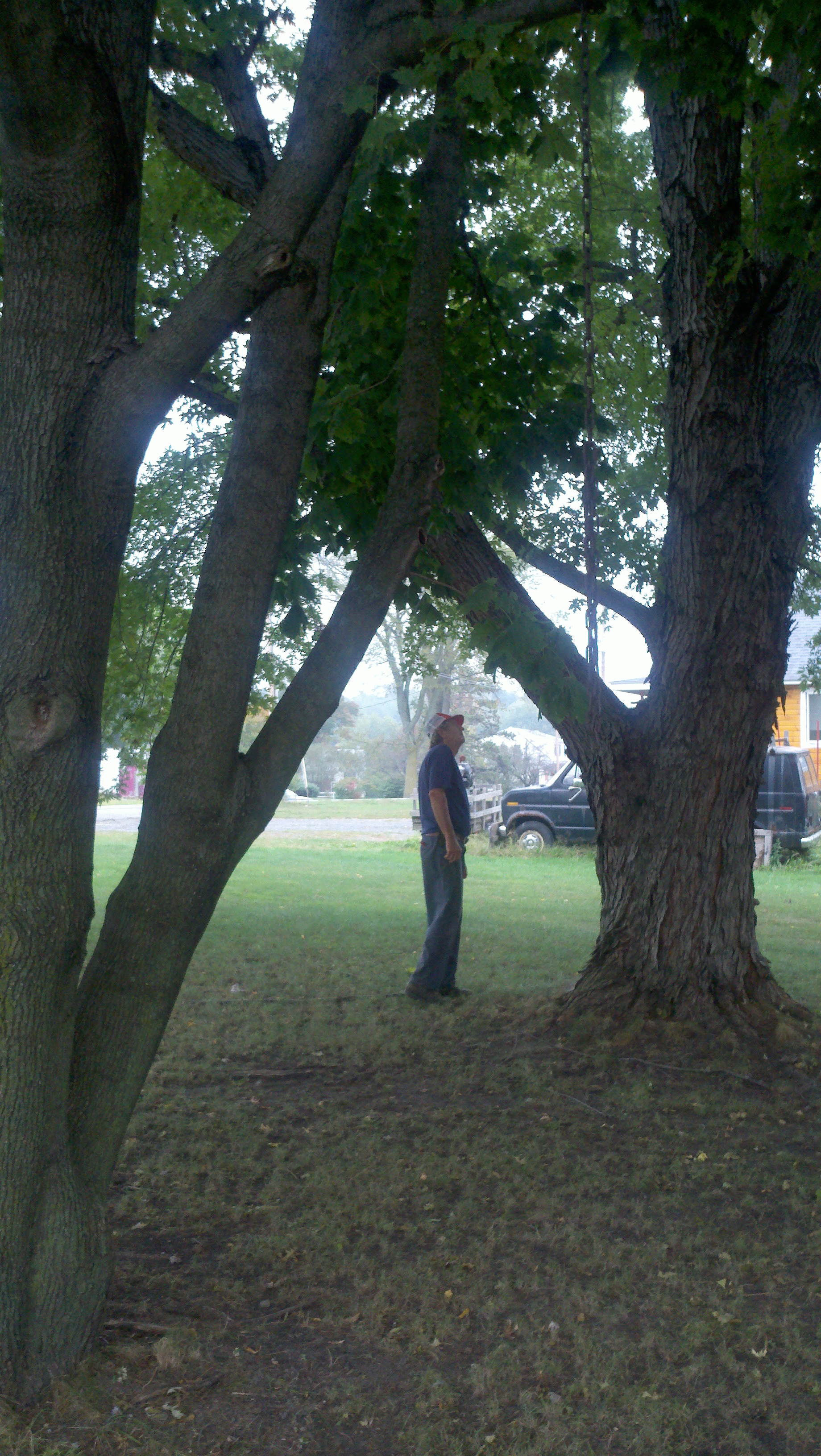
I told my dad and everyone at the grader what was happening. My dad says, “hmm … how they know, they must smell them or something.” I said, “looks like the squirrels are taking all of your nuts.” My dad replies, “I’m going to follow them and take them back.” I replied, “looks like they are winning here.” In response he said, “it’s two against one, that’s not fair.” He chased them to our neighbor Moose’s yard. They went up a tree and also tried to hide some of the nuts in different little spots on Moose’s yard. He gathered what he could, the squirrels watching helpless … for the moment.

Image

My dad went back to our yard and proceeded to gather all of the nuts he separated from the shell and put them in a bucket and covered the bucket. He had the last laugh … or so he thought …..

About 10 minutes later I look back out towards my house and the squirrels were not so easily deterred. They knocked over the cover to the bucket. So in response my dad took away the ones he already had shelled. But they weren’t so easily deterred.

The squirrels started to shell the unshelled nuts he had left. By the way, they furiously licked those nuts before they scurried away with them, almost as if they knew his counter-plot to steal them back. They then started working on the ones that weren’t shelled. One after another after another they shelled, licked furiously and scampered away with the walnuts. Doubling over with laughter I called my dad, “you better do something quick, or you ain’t gonna have no nuts left.”

ImageImage

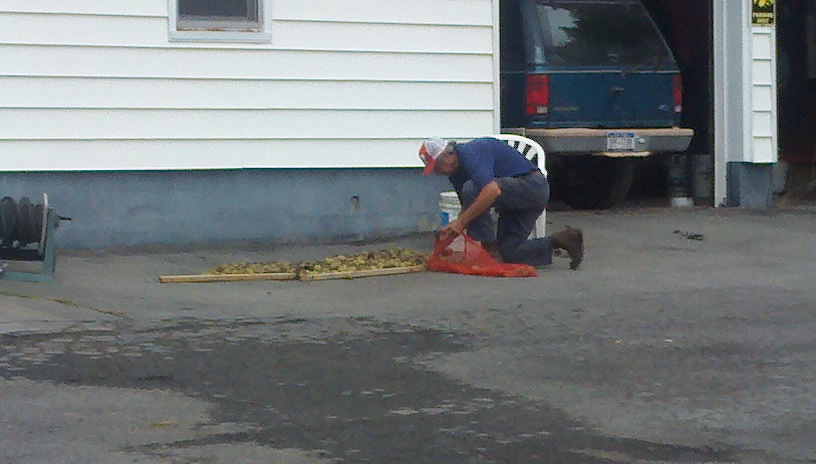
Quickly my dad grabbed some onion bags and started to put the nuts in them. He then hung them in the bag on the clothes line, and went back to the barn. What do you think happened a few minutes later?  Yes, ladies and gentlemen, in this instance on man versus nature, score one for the squirrels.

I have photographs of all of this, as you can all see.

Say hello to Boris, the maybe vampire peddler who wants back fat from pig!

The following is an excerpt from my yet unpublished memoir, “Muckville: Farm Policy, Media and the Strange Oddities of Semi-Rural Life.” This little vignette is about my encounter with an Ukrainian peddler named Boris who might be a vampire and was in great need of large quantities of back fat, from pig.

Image

Excuse me, do you sell back fat from pig?”

On August 17th, 2010, we were harvesting onions. I was working the big field lift on the yard. My brother was driving the harvester and my dad was out and about for some reason. Between one of the army truck loads of onions, a guy pulls in with a van. He is obviously a produce peddler. I say “obviously” because we deal with these types all the time. They usually sell to small markets and specialty stores and bodegas in NYC. They are of some foreign origin, either Korean or Russian or something else, where you have an extreme difficulty in communicating with them. Universally, they want everything cheap, and they are mostly a pain in the ass.

The guy gets out and he starts to talk to me. I’m too far away to hear at first clearly so I have him repeat what he said. His accent is thick and he sounds Russian. I later learn he is Ukrainian. He sticks out his hand and says “I am Boris” and then asks about onions and butternut squash (he sees a bulk box of squash next to the door.

And then he asks for something I have never been asked for before: “I need 2,000 lbs, every month, of the back fat from the pig.”

Excuse me? That was a new one. I paused for a moment, and without cracking a smile, because he wasn’t, I bit and asked “what for?” He was a little cagey on that detail, and never really gave me an answer. I prodded, “to barbeque?” He laughed and said “no, no, no, you don’t barbeque back fat from pig.” He then kept emphasizing,

in his thick Russian accent he needs lots of back fat … from pig. “And it must be 2, 3 inches thick, you understand?”

I responded with, “dude, I grow onions, not pigs, I really can’t help you there. Did you try the Quaker Creek Store next door?” “Yes, yes, they only have a little, I need 2,000 to 3,000 lbs, every month. And it MUST be 2 to 3 inches thick.” “Of course it must, who the hell thin slices back fat from pig,” I responded with. I had no idea what the hell we were talking about.

He then asked me for some cucumbers and other greens that I don’t grow so I suggest he call my neighbors, Ray and Gary Glowaczewski, who grow all sorts of stuff and sell them at various greenmarkets. I gave Boris their office phone number that he immediately calls on his cell and he starts talking to their mom, Ceil. He doesn’t preface the call with “Hi, my name is Boris and I like to buy produce from you” in his thick Ukrainian accent but instead says this in his thick Russian accent:

“Hello, I want to come visit and speak with you. Tell me where are you? What is your address that I may come visit with you now?”

Their mom was not disclosing anything to Boris. So Boris handed me the phone and I had to tell her that he was a guy interested in produce, and I added “he appears to be harmless.” Boris nodded in agreement. I left out the part about the back fat from the pig. She thanked me and then told Boris where their farm was located at (about a mile down the road).

Before he left we started talking about the back fat again. He repeated that he could move 2,000 pounds a month, easy. I asked. “Is there, like, a back fat holiday season coming up or something?” He looked at me quizzically and then smiled and said, “not really, but you would not like it, you have to start eating the back fat when you are this tall (he held his hand up about 2 feet high) in order to like it.” I didn’t question the veracity of that assertion. He then shook my hand and left to go to the Glowaczewski’s in search of cucumbers and presumably, “back fat from pig.”

But that was not the last that I saw Boris. Later in October my dad and I were working in our barns installing our own insulation in the ceiling. We were elevated by a very unsafe, if not dangerous, in my humble opinion, elevated platform constructed by my dad. It was a series of skids, boards and the like, elevated higher by two forklifts.

I hate heights as it is, I really hated this.  We were roughly 16 feet in the air. I hear him pull up and he starts calling out “hellloooo” in the barn, looking for us.

I yell down from my perch “Who is that? Is that you Boris?”

Boris responds, “yes, it is me!” I ask him, “are you still looking for the back fat, 2, 3 inches thick?” He quickly replies, “from pig, yes!”

So I climb down and shake his hand. I tell him, soulfully, that I couldn’t locate any sources for his pig back fat, YET, but I’m working on it. He then asks if we have onions in 10 lb bags and we tell him no, just in 50 lb bags. My dad, always the salesman, then tries to sell him squash. Boris says, “I buy one bag tomorrow, to see what my customers say.”

We then talk about my fear of heights. He talks about some supervisor job he had somewhere in Europe “where he was many feet high” where he was scared at first then no more. I have no problem admitting I’m a wussy.

At this point I whip out my Droid X to take a picture. I tell him, “Boris, I need to take a picture of you and my dad. I always take pictures of my best customers.” I can truthfully say this, because he actually bought a bag of onions. Boris smiles, just a little. But my Droid X camera craps out 3 times!!!!!!! I can’t take his picture!

Frustrated I exclaim, “Boris, I can’t take your picture. Are you a vampire or something?” Boris pauses a brief moment and says, “nah, (short pause) I don’t think so, (another short pause) maybe.”

I thought about asking him if somehow is maybe being a vampire was related to his need for large quantities of back fat from a pig, but I was afraid of experiencing a real life “True Blood” moment and didn’t want to push it. He did mention again the back fat issue and for some reason he thinks I’m the local go to guy to get it. When we exchanged business cards outside he made sure to show me, with his thumb and finger, what a “good, fat 2, 3 inch” looks like, not 1 or a “pretend 2 inch.” I dutifully nod my head, in knowing agreement. We are starting to establish a genuine back fat bond.

If anyone out there reading this has any tips on locating some back fat, from pig, please pass them along. My almost vampire friend Boris from the Ukraine who is no longer afraid of heights would be very appreciative.

The reincarnated Larry, Moe and Curly came to my farm to buy onions today

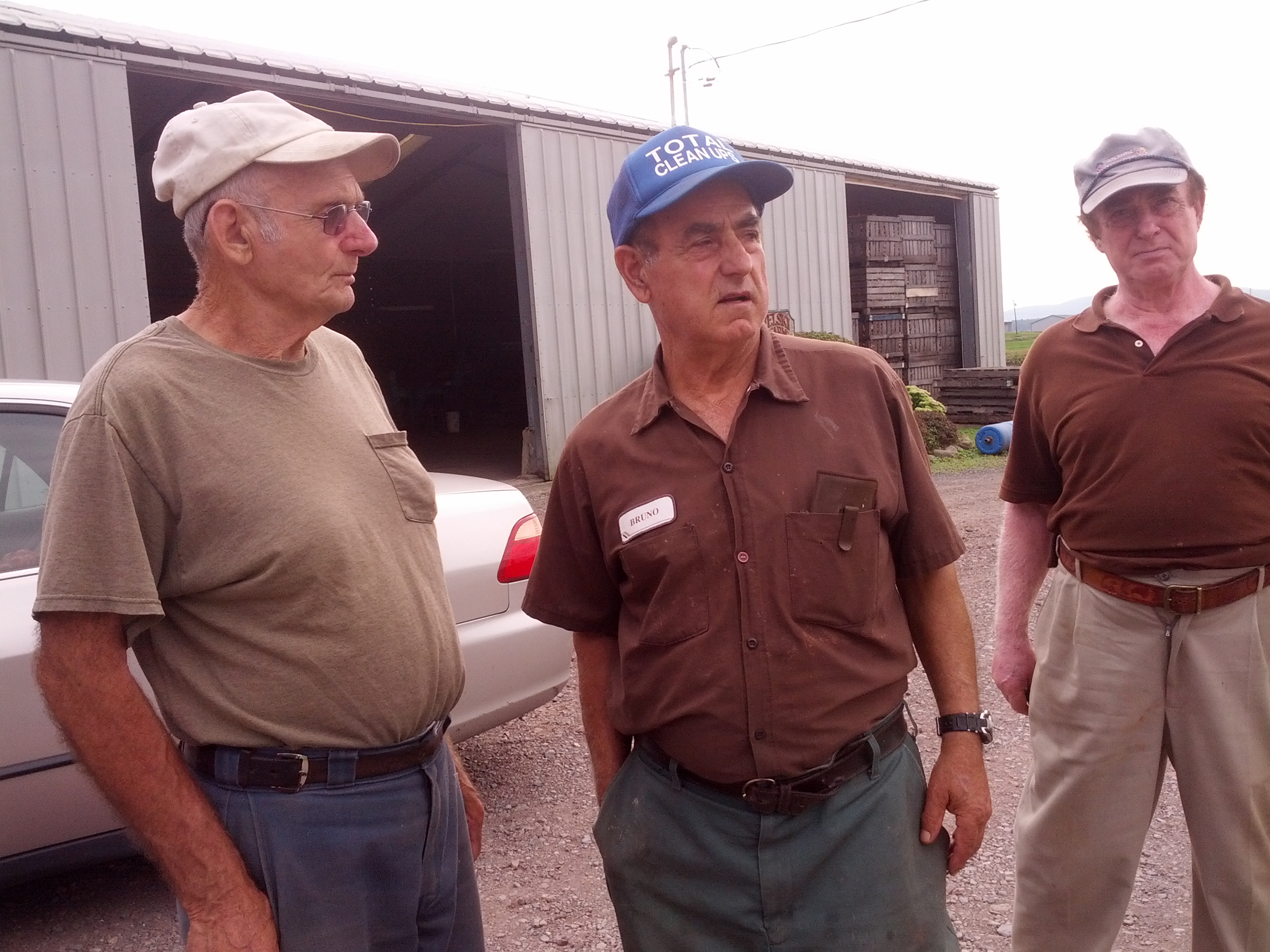
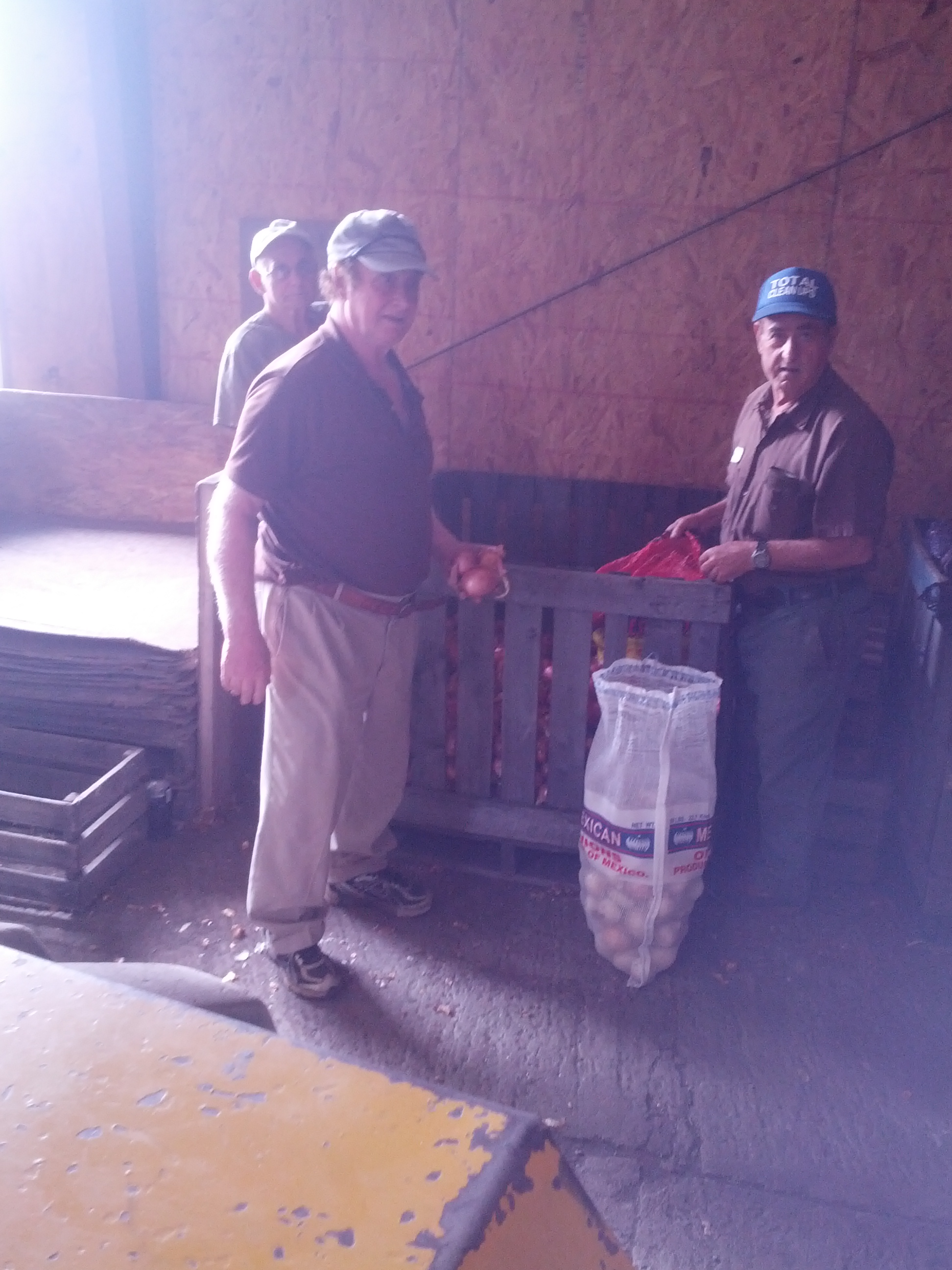
Today, like most days during late July thru late September was really busy. We were harvesting about 7 acres or so, and a car pulls in. Sometimes people that have been stopping by for years pop in to try and buy some onions. Sometimes total strangers just pop in looking to buy some onions. That latter happened today when during a lull between trucks a car pulled in and these three characters popped out:

Image

As soon as these guys started waddling around I thought to myself, “oh crap, it’s Larry, Moe and Curly.” I wasn’t far off.

When they pulled in I was busy on the big field forklift bringing onions in the barn so they would be dry for grading and packing tomorrow. I really didn’t have time to stop. Once a full army truck pulled in I had to stop and work on on unloading the truck. So, I let my dad handle these characters, it’s right up his alley anyway.

Image

As I kept bringing the boxes in I watched as they walked all over the place … taking a handful of onions from one place, then from another … my dad right behind them, showing them around. We get people like that, real pests … want a 10 pound bag of onions, or even a 50 pound bag, but balk at the absurdly cheap wholesale price we charge and offer us cash … as if we really will get one by the taxman because we sold some doofus 50 pounds of onions for a dollar less which we won’t report. We always tell these people, “we’re getting paid $12 per 50 pounds for 900 bags, and getting paid in 30 days (usually), why do I need to sell you a bag for $10?”

Well, going back to the customers today, as I watched them I thought to myself, “hey, these guys are a step down for Larry, Moe and Curly, I mean look at the shirts, and hats, and pants, and the way they walk, all that was missing was an occasional eye poke and ‘nyuck nyuck nyuck.'”

I had to stop and talk to them. First, while I was still on the forklift and Miguel was removing a cover off a box, I surreptitiously snapped some photos of them as they dug in a box:

ImageImageImage

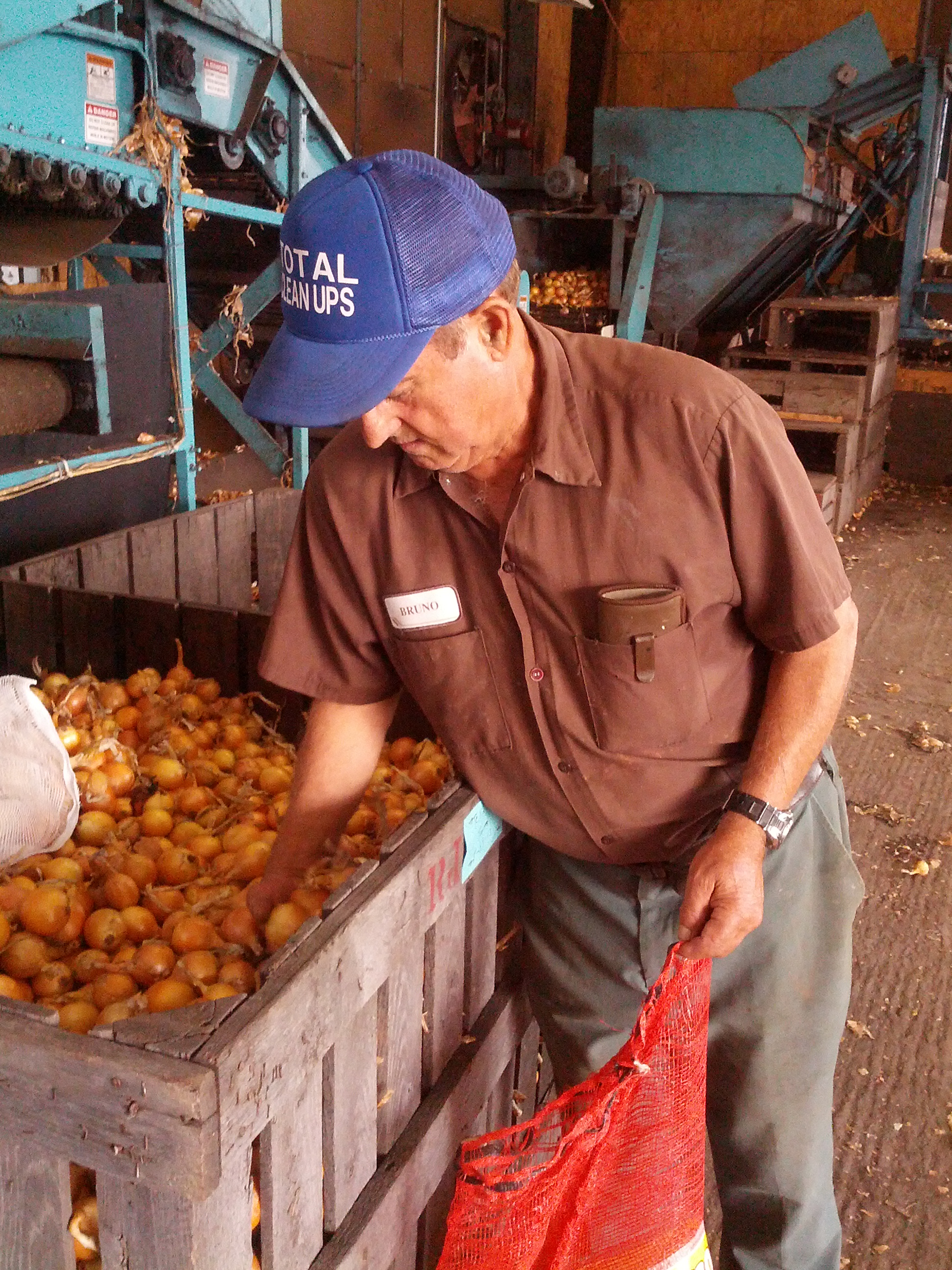
I then engaged in conversation with the guy wearing the hat that said “Total Clean Ups.”

Image

Me: “So, where are you fellas from, are you local?”

Total Clean Ups (in an ethnic accent I couldn’t at first place): “We’re from New Paltz. We got a farm, but not like this, small place, and we don’t grow onions.”

I looked at his shirt and noticed the name tag.

Me: “Your name must be Bruno.”

Total Clean Ups: “Nah, my name is Larry. Bruno is my brother, my other brother, I just wear his shirt after work.”

He then went back to work, furiously digging through a box of undersize onions. At this point the man with the white cap approached me. He had a raspy voice and a slight accent, one that sounded Polish.

White cap: “You guys Polish? Those two (motioning to the other other two guys, now both furiously digging through the box) are Italian.”

Me: “Are you all brothers?”

White cap (laughs): “What? No way! Those two are brothers. They are crazy! I’m just a friend. (yells to Larry) “Hey Larry, what are you going to do with all those onions?” (then continues with me) “They’re crazy, and their other brother is crazier yet.”

Me: “You mean Bruno?”

White cap: “Yeah! hey, do you know Bruno?”

Me: “No, not really, though I did meet his shirt.”

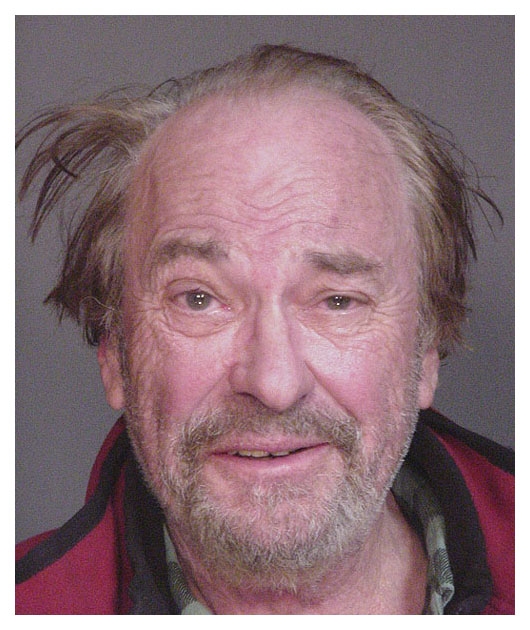
At this point the brother of Larry, who looked like Rip Torn in one of his mug shots and whose fly was on the way to being fully open, approached me. I was a bit apprehensive because White Cap did say he was crazy.

Actually, he looked like he was the byproduct resulting from a romantic encounter between Rip Torn and Bela Lugosi.

riptornmug1Unknown

Fly open: “Hey, when are you going to start digging the potatoes?”

Me: “Uhm, never. I don’t grow potatoes.”

Fly open: “WHAT? Get out!”

At this point these 3 Stooges started to load their car … with White Cap repeatedly asking the crazy brothers as he scratched his chin “what are you going to do with all these onions?”

Image

At one point White Cap grabbed a 50 pound bag which held about a dozen onions in it or so.

White Cap: “How much for this?”

They were buying over 200 pounds of onions … why did he need that? As I looked at the bag I think it contained onions that suffered mechanical damage and were just bagged to get them out of the way. I thought for a second and said:

Me: “I don’t know … why don’t you just keep it for free.”

He gave me a big smile. At this point an army truck full of onions pulled in and I had to go. I paused for a moment and wistfully hoped that one day my 3 Stooges would return for more onions to my farm.

More harvesting ….

So, you’ve seen a glimpse of what it looks like as we harvest on the field, well, here is what happens on the other end on the yard.

So, Eve shot this video of what happens when we harvest onions on the yard with our new Sony HDR-PJ650 Handycam. I then put it together in iMovie.

We finished harvesting a field of my brother’s transplant reds (Bejo’s Redwing) and moved on to start a field of my dad’s yellow transplants (Bejo’s Braddock). The music I added was the same music playing on my phone and into my earphones as I worked.

A first experiment with the new technology …enjoy!

Harvesting!

Ever wonder what it is like to drive a 2 and a half ton army truck while harvesting onions?

Check it out:

For occasional photos of farm work as well as unusual musings follow me on Twitter:

https://twitter.com/ChrisPawelski

Enjoy!

Moving a barn …

Allow me to formally introduce my dad, 3rd generation onion farmer Richard Pawelski.

dad

My dad is a thinker and a doer. As he often says:

“I have an idea stuck in my head.”

Frequently these ideas come to him in the middle of the night. They percolate and then come to fruition. Frequently.

Sometimes these ideas which get lodged in his head are good things. He’s always on the hunt for scrap lumber or tin and is always building something, or taking something apart. As our good friend Tom Savaglio has remarked, “you are a cobbler Rich, always doing something!”

The piece of property between my house and his, called “The Cemetery,” is filled with incredibly large Rich-made structures all put together with cannibalized wood and other materials. “I only had to pay for the nails” he has often remarked.

As I said, sometimes these projects work out quite well … sometimes, not so much. Sometimes he is not so easily dissuaded from one of the “ideas stuck in his head.” Allow me to share the narrative of one of those ideas.

See this barn on my yard:

barn today

That barn years ago used to be on my dad’s yard. here is a vintage photo of it when my brother and I were really young (this pic is from circa 1971 or so):

old-barn-photo-copy-2

At some point in our early childhood my dad cut the side of the barn off and moved the primary structure to a different spot in his yard. I don’t recall how exactly he moved it, but I faintly remember him doing it.

Well, he then decided, sometime in the early 80’s, that he was going to move it from his yard to my grandmother’s yard (where I live now and it sits to this day) so all of his primary barns would be in one location. How was he going to move it?

He was going to take this forklift:

forklift

He was going to drive into the barn, lift it and have it balanced on the forklift, then he was going to drive it down this 1,000 foot driveway:

driveway

And then drive it over 1,500 feet down Pulaski Highway to the other yard:

Pulaski Highway

I am not making any of this up. I remember, distinctly, everyone protesting this idea, me, my brother, my mom, etc …. We thought it was insane, but, as usual, my dad was not to be deterred. He even enlisted our neighbor and his good friend Ed Ratynski to stop traffic along Pulaski Highway as he slowly drove the barn down the highway.

I asked my dad the other day what happened next, and as he recalled, chuckling about it:

“I thought it would work … I had the idea in my head. But then as I started down the driveway, and the driveway wasn’t even, the barn started tilting toward the ditch. Then I decided it wasn’t a good idea and went back up the driveway.”

Another neighbor eventually suggested putting the barn on a wagon and then driving through the black dirt fields between the properties to the new location. And voilà the barn was moved!

In recapping this event with my dad the other day he lamented:

“I should have left the barn where it originally was, before I moved it the first time. The yard would have been more picturesque.”

But, if he hadn’t moved it we wouldn’t have had this story!

After moving it to its current resting place my dad built another side addition with his scraps and “timbers” and it houses a number pieces of equipment, including one of our AC-G’s, our Cat-22 and under the side addition our ditchbank sprayer, fertilizer spreader and Case 350. It is quite useful.

A big week in the media for me this week!

Well, a banner week in the media for me this week!

First, on Tuesday night I, along with Cornell University Professor Margaret Smith, was a guest on WSKG’s “Community Conversation” program, hosted by Crystal Sarakas. The theme of the hour long show was “Genetically Engineered Foods.” It was a blast and Crystal was a spectacular host!

http://www.wskg.org/episode/genetically-engineered-foods

Then on Wednesday I was interviewed by the always wonderful Blasie Gomez for a story on News12 on how the hot weather has been affecting the local crops:

http://hudsonvalley.news12.com/news/orange-co-famers-report-crop-damage-amid-heat-1.5713175

Finally on Thursday I was interviewed by the equally fantastic Meredith Zaritheny for a story on YNN on how farmers have been dealing with the heat:

http://hudsonvalley.ynn.com/content/top_stories/673899/farmers-working-in-the-sweltering-heat/

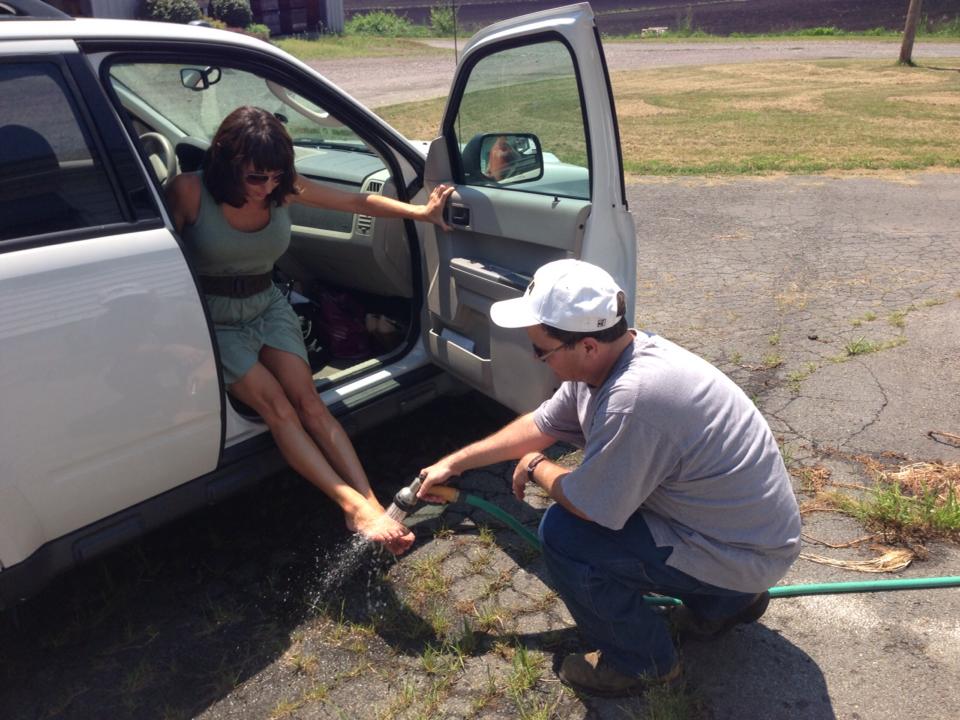
The highlight? Well for both Blaise and Meredith after the story I got to wash their feet, tho I only have a pic of my rinsing of the feet of Blaise Gomez:

Image

While I didn’t get a pic of my washing Meredith’s feet I did get a pic of Meredith talking to her #1 fan, my dad. The following exchange actually took place:

Dad: “Hey Meredith, want to pull some weeds?” Meredith: “No!”

Image

My dad did get catch a glimpse of Blaise and remarked to our employee Shorty as they watched Blaise walk down the field: “God is good.”

It needs to stop raining now …

How mucky is the muck? Very mucky, very soggy, very boggy, very wet! It just keeps raining and raining and raining and raining. In less than a month we have gotten over 9 inches of rain.

Here is a recent YNN story I was in about the situation:

http://hudsonvalley.ynn.com/content/top_stories/671597/hudson-valley-farmers-concerned-about-flooding/

Here is recent Tracy Baxter story from the Times Herald-Record website:

http://www.recordonline.com/apps/pbcs.dll/section?Category=MEDIA09

Here is the video alone:

Every other year since 2005 we have either had a flood of some sort or excessive rains.

In 2005 we had 2 “50 year floods.”
In 2007 we had a “50 year flood.”
In 2009 we had an excessively wet June and July (see my submitted written testimony which you can download via this link for details on the effects of that rains: http://www.ag.senate.gov/hearings/expanding-our-food-and-fiber-supply-through-a-strong-us-farm-policy).
In 2011 we had 2 “50 year floods.”
In 2013 we are excessively wet.

What exactly is happening to my onion crop? Essentially my onions in certain parts of my fields are drowning. They are turning yellow, they are melting down and not only not producing new leaves they are losing old foliage.

I will later today post photos.

What can I do about it? Not much. I can hook my fields in an attempt to try and dry them out. I’ve done that twice already but I can’t even think of doing that again until the ground dries out.

I can add fertilizer, particularly some form of nitrogen. I’ve done that once already.

I can add a foliar feed to my fungicide/insecticide spray package. I’ve done that once already as well.

Apart from that there is not much else I can do.

Welcome to the life of a farmer!

A new tv appearance.

So, I appeared on tv back on May 10th in a story on YNN about the top priorities for the next Farm Bill that Rep. Maloney’s Agriculture Advisory Committee issued in a report.

My fantastic friend Sharon Soons does a fantastic job in the piece!