Did I mention Best Buy, Sears, Home Depot, Starbucks, Subway, etc …?

https://fundrazr.com/campaigns/1efvb/ab/61mkb2

Okay, it’s been a couple of days with this Crowd Funder TV Show campaign and as I mentioned in my last couple of posts, If you plan on shopping at:

Best Buy

Sears

Home Depot

Starbucks

Subway

… if you plan on spending any money there anyway you can back my campaign to help me raise funds for an editor for my unpublished but first draft completed memoir, “Muckville: Farm Policy, Media and the Strange Oddities of Semi-Rural Life” and receive a matching gift card from those locations. In other words, you can help me with my publication without spending a dime extra. That’s called win-win.

And my Kickstarter campaign which ends in 9 days (and is only 30% towards goal), if I don’t reach the goal I get nothing. This campaign does not work that way.

I hate asking for your help. I really do. But after numerous years of devastating weather events

… I simply don’t have the funds to do it myself. I wish I did.

Why is this matter to you? My prologue for “Muckville” puts it best:

Muckville.  I can see you asking yourself now

Why should I care about a book about farming? Or one about public policy advocacy and dealing with the media? Or a about a book that combines the realities of farming with agriculture-specific policy, advocacy and dealing with the media?

We all have to eat. Every day if possible. Day after day. Until we die we have to eat. Food, along with breathable air, clean water and adequate shelter is one of our most basic needs. Since there are roughly 3.3 million farmers in the U.S. comprising roughly 2% of the general population, odds are you have never met a farmer. Despite the growth in popularity of Community Supported Agriculture (CSA) and local farmers’ markets it is most likely you have never met, spoken, smelled or touched a farmer.  Or set foot on a farm.

Though the United States was once a primarily an agricultural society and even as recently as the turn of the previous century roughly 40% of the population farmed, since then, and especially since the advancements associated with Norman Borlaug’s “Green Revolution” fewer and fewer farmers on less and less land space have produced one of the world’s safest, most abundant and cheapest food supplies.

And with that change has come an incredible level of disconnect between the people who primarily produce our food and the citizens who eat it. Sadly, when you mention the word farmer the first image that will pop into someone’s head will be Eddie Albert’s character Oliver Wendell Douglas from the CBS sitcom “Green Acres.” Or worse, some character from one of the various reality TV shows that keep popping up, and frequently aren’t so real.

Though farmers’ markets are exploding across the country and thanks to the foodie movement there is a strong renewed interest in agriculture, much of the information about farmers is not coming from us. Food critics and chefs will frequently pontificate about farming, and though some of them may have a small hobby farm, for the most part they are not farmers. They do not know what it is like, on a day to day basis, to be a farmer in the 21st century.

I simply don’t have enough heads for all the hats I have to wear. I have to be a soil scientist, a chemist, a financial planner, an accountant, a bookkeeper, a regulator, a marketer and frequently a public relations person and public policy advocate.

Farming today is governed by a myriad of laws and regulations that cover numerous aspects of our business on multiple levels. And there are so many groups, organizations and pressures out there trying to influence or change those laws and regulations on a seemingly daily basis.

In the mid 1990’s after leaving the farm a short time to pursue my graduate degree and after I married my wonderful wife Eve, I returned to the family onion farm. My brother and I are the fourth generation of the same family on a farm that started in the U.S. at the turn of the 20th century. As soon as I returned I started dealing with a variety of issues and crises, including weather disasters and various labor advocacy organizations. I was baptized by fire. Eve and I had to learn, for the most part on our own, how to fight for our farm and our industry. It wasn’t easy at first (for the most part it still isn’t now, 17 years later).  But, trial by fire typically isn’t.

So why is this all important to you? Because as I said, we all have to eat. It’s one of our most fundamental needs. You should know something about how your food is produced. Not from sitcoms, or from food critics or from chefs, no matter how well intentioned they may be.  You should know from one of us who produces it.

Now, there are some books out there written by farmers about farming. Many of those books are about the adventures of people who eschew urban or suburban life to move to the country and take up farming. They extol the benefits of a more simple life.

That’s not the point of this book.

Life is not simple, nor, quite frequently, very fair. A hailstorm that decimates your crop mid season or a hurricane caused flood that wipes virtually your entire crop away is not fair. And how you deal with those scenarios is anything but simple. I’ve dealt with those situations, sadly, more than once. I’ve also dealt with very stupid government programs and terrible proposed legislation. And over the years my wife and I have had a fair number of successes in dealing with such situations. That’s what this book details.

Though it is a memoir about my specific experiences on the farm and in front of a camera or on Capitol Hill, what I relate, the techniques and the tricks and methods of dealing with the media or developing grassroot strategies to fight for a given issue can be applied by you. No matter what you do, or where you live, or what problem you may be facing, my example can provide you with a roadmap to how you can successfully fight for your cause.

The system is messed up. It sucks, to  be quite frank. But my specific experiences show that if you are persistent and you have a fraction of a clue as to what to do, you can make a positive change for your community, too.

Why should you read this book? Because I need better informed end users of my product. I need you to understand why after a devastating hailstorm or flood I need your support and help. I need you to have a better connection with the people who produce the food you eat.  And, you need to better understand the people who grow your food, and how the policy decisions can affect every aspect of the food you eat.

Why should you read this book? Just as important as learning about how your food is grown, I want you to read it and to realize that you can get off the couch and fight for your family and your community. Though the deck is stacked against you, like it is against me, you can still effect a positive change. All is not bleak. There is hope.

I  want you to read this book so that the next time you walk into the produce section of your local supermarket you will pause for a moment and just think about what was involved to get those fresh vegetables and fruits on that shelf.

So, any way you can help is very much appreciated. For those of you that have already backed me I can’t thank you enough!
Can you shop and support a worthwhile project at the same time?

Will you be doing any shopping at the following locations in the next few weeks?

Best Buy 

Sears

Home Depot

Starbucks

Subway

As you know from my last blog post my project to raise funds for an editor for my unpublished memoir “Muckville: Farm Policy, Media and the Strange Oddities of Semi-Rural Life” has been taken up by the Crowd Funder TV Show:

https://fundrazr.com/campaigns/1efvb/ab/61mkb2

Link for their website:

http://www.crowdfundershow.com/ProjectCrowdFund/index.jsp

Their campaigns are distinctly different from Kickstarter in 2 ways …

1. It is not “all or nothing”
2. The rewards are dollar for dollar matched gift cards

That’s right, if you back me for $25 you get a $25 gift card, possibly from a place you were planning on shopping at anyway. It is essentially donating to my project for free, if you plan on shopping at any of those locations.

So, I hope you can back me and spread the word. Once the segment from their TV show goes online I will post it as well. Again, thank you all for your support!

Here is a link to another past segment from the show:

Exciting Muckville news … my campaign will be featured on the Crowd Funder Show!

https://fundrazr.com/campaigns/1efvb/ab/61mkb2

I have exciting news … my campaign to raise funds to hire an editor will be featured on the Crowd Funder Show!

What is the Crowd Funder Show and what does it mean to appear on the show? According to their website:

The Crowd Funder TV Show highlights various ideas that have been selected based on their merit for creativity, social relevance, and commercial viability.

Each episode focuses the spotlight on six or seven inspiring projects and personal goals that give the viewing audience insight into the campaign, its principal, and the reason(s) why it should come to fruition.

The Crowd Funder TV Show highlights various ideas that have been selected based on their merit for creativity, social relevance, and commercial viability.

I initially contacted them for my campaign to appear on their tv show (it currently airs in parts of NYS and Canada, as well as online). What I did not realize is that when a project appears on their show they create an entirely new crowd funding campaign for it. In other words, this campaign is entirely different, separate and distinct from my Kickstarter campaign. Their campaign has a couple of distinct differences from Kickstarter.

1. Everything that is raised is kept, it is not “all or nothing” like Kickstarter.

2. The rewards are very different.

Again, from their website:

Viewers can choose to support the projects they watch by contributing directly to the campaign website or by calling a toll-free number.

The Crowd Funder Show rewards contributors with sponsored gift cards for the same amount of money they contribute, up to $100.

Supporting people and their projects has never been easier so it’s no wonder you can’t help but feel like you’re a part of something special.

The Crowd Funder TV Show is an interesting, inspiring program that highlights human ingenuity and co-operation.

When you go to my page you will see locations once can choose from for the gift card include:

Best Buy

Sears

Home Depot

Starbucks

Subway

Amongst others ….

If you choose to support me at the $25 level you can choose to get a $25 gift card from Best Buy as a reward.

So, if you are planning on shopping at any of these places the coming weeks, or are looking to give gift cards as gifts from any of these places, you can essentially choose to support me at no additional cost to you!

So, can you support me and my campaign to raise the funds for an editor for my yet to be published memoir? If you do not only are your supporting a very worthwhile endeavor but you can get fantastic gift cards from places you already shop from. And can you spread the word about this to all of your friends via your various social media platforms?

And to the extremely generous people that have already chosen to back my Kickstarter campaign, thank you once again! If my campaign on Kickstarter fails (and as each day passes it looks like that is likely) I hope you can support me on the Crowd Funder Show page. You will be helping me out and getting a great gift card as well.

Once the video segment of my campaign is posted online I will post the link. In the meantime thank you so much for your support and please spread the word!

Sample episode of the show:

Today is Giving Tuesday!

You may or may not be aware but now do we not only have Black Friday, Local Saturday and Cyber Monday but now we have Giving Tuesday (#GivingTuesday) …. a day devoted to giving back a bit to the community.

http://www.usatoday.com/story/news/nation/2013/12/01/givingtuesday-charity-day/3797705/

My Kickstarter campaign might be one way you can participate in this event. My memoir is all about the sorts of things Eve and I have done over the years on a volunteer basis to help out our community locally and the farming community at large.

Can you help me?

http://www.kickstarter.com/projects/1176629437/muckville-a-memoir-of-the-public-policy-life-of-a-0

Any and all help is very much appreciated. My campaign has stalled a bit. Please help if you can.

And again, thank you!

Thanks for all the kind comments!

First, my apologies for taking so long to post this. I’m still getting a handle on this blog and a number of comments came in for approval that I just didn’t notice at first. They were put in the spam box and I was not notified of them. Hence, my need to check my dashboard more frequently!

Thanks to all of the positive and nice comments I have received recently about my blog and blog postings. A few have asked about the blog format, well, I’ve used one of the free WordPress formats. I’ve looked at some of the other themes but I really like how this one is laid out the best.

Again, thank you!

And please continue to spread the word about my Kickstarter campaign … less than 13 days to go and only 25% of my goal. If you can back and/or get your friends to back … that would be fantastic and very much appreciated. Please help my book become a reality!

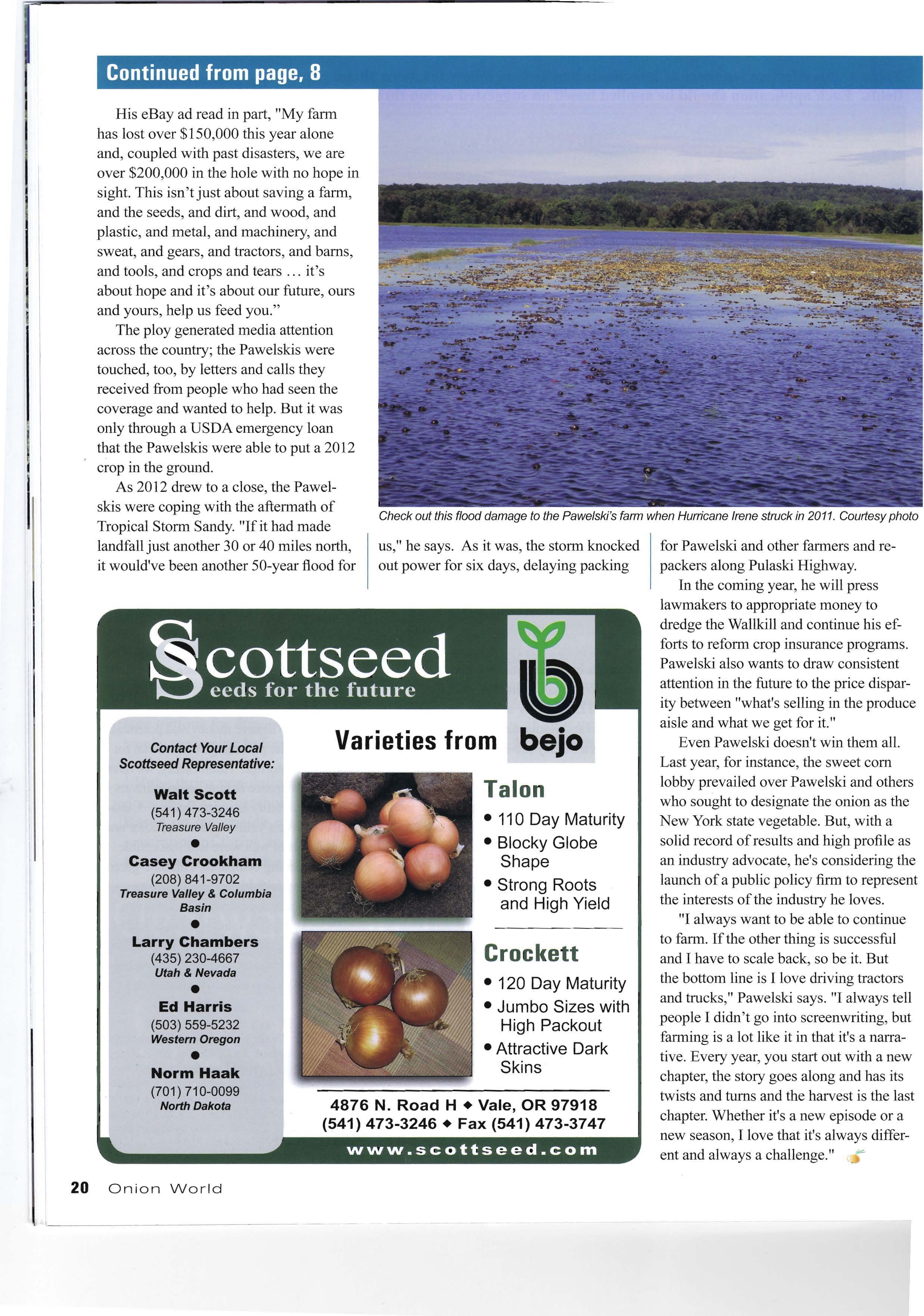
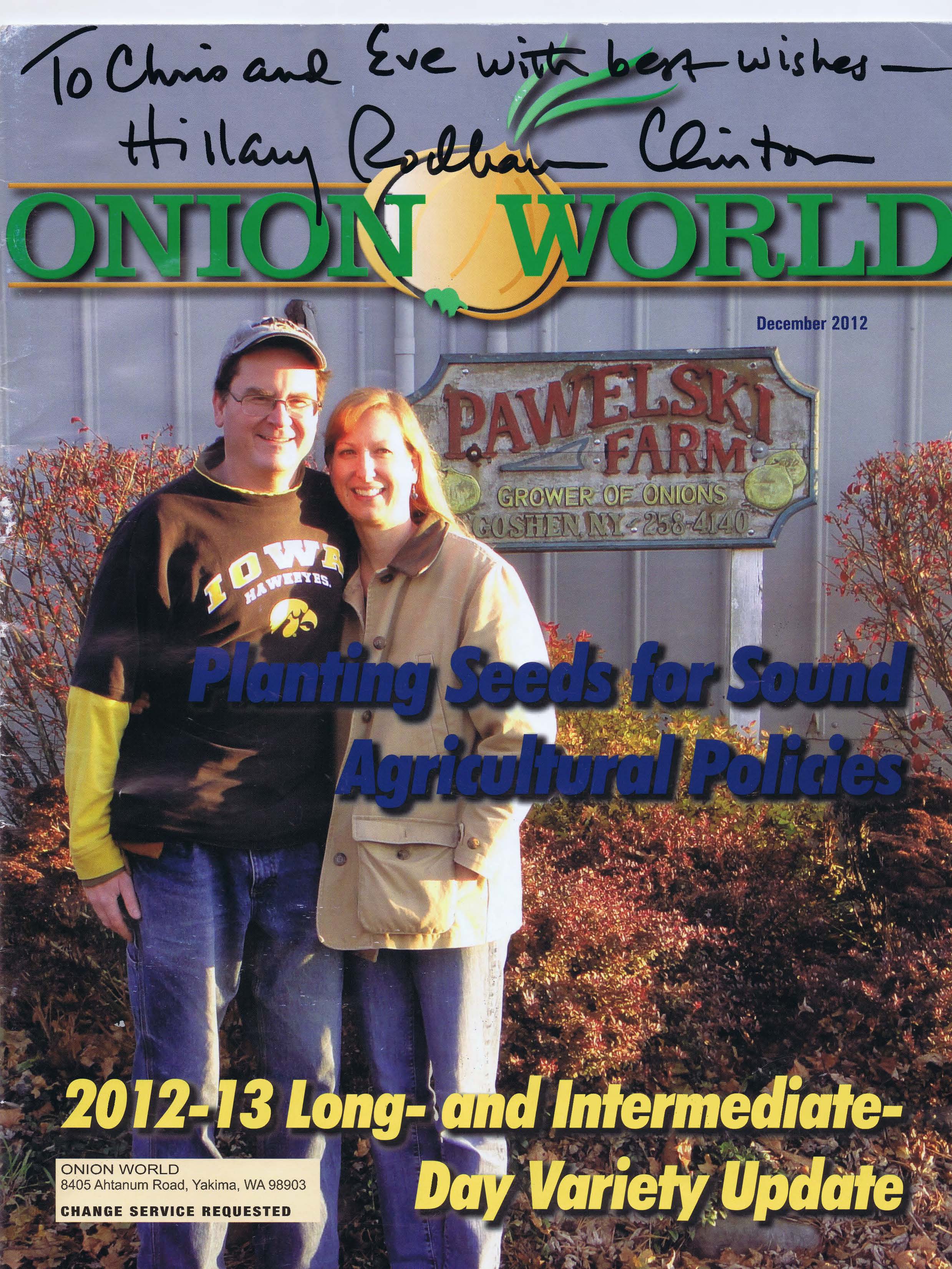
Onion World December 2012 Issue

Since I’m in the midst of this Kickstarter campaign (had you heard about that?) about my memoir “Muckville: Farm Policy, Media and the Strange Oddities of Semi-Rural Life” and I just uploaded the old National Geographic article I figured I’d upload this neat article from the December 2012 issue of Onion World Magazine (no, not “The Onion”) about Eve and I’s public policy activities over the years.

Want an idea of what my memoir is about? Check out this fantastic article by Eric Woolson to see just some of the stuff we have done over the years in terms of agricultural public policy and advocacy (Yes, the front cover is signed by former Senator and Secretary of State Hillary Rodham Clinton!).

ImageImageImageImageImageImage

Link for article: http://digital.turn-page.com/i/102943/3

Supporting my Kickstarter campaign, helping me get my memoir out there, helps me to better be able to do the things detailed in this article!

Again, THANK YOU!

Link for Kickstarter campaign: http://www.kickstarter.com/projects/1176629437/muckville-a-memoir-of-the-public-policy-life-of-a-0

It’s simple …

http://www.kickstarter.com/projects/1176629437/muckville-a-memoir-of-the-public-policy-life-of-a-0

At the halfway point of my Kickstarter campaign 35 people (including a big one yesterday) have stepped up to the plate to really help.

But, we have only 14 days left, halfway to go but we only have met 25% of the funding goal.

Can you help? Can you back and spread the word?

Love the onion!

Image

In the meantime check out this podcast interview about my campaign in case you missed it!

http://www.blogtalkradio.com/wrightplacepodcast/2013/11/18/muckville

So, please spread the word, back if you can, and in the meantime enjoy a little Frank:

Another small portion of my memoir …

The following is another brief excerpt from my yet unpublished memoir, “Muckville: Farm Policy, Media and the Strange Oddities of Semi-Rural Life.” This small section of my memoir deals with the backstory to 3 different media pieces I was in back in 2000.

In late March of 2000 I was invited to go down to Washington D.C., to be video interviewed by the Senate Democrat Policy Committee (this was due to Brooke recommending me to the Committee). The video interview would be incorporated into a video that highlighted the committee’s positions regarding the upcoming Farm Bill. They needed “b-roll” footage of me doing farm work for the video so prior to my trip I got Cable 6 News to do a story about the trip, and to send their “b-roll” footage to the Committee, which they graciously did. In that piece I pointed out that in 1999 I had 50-100 buy-up coverage (50% of my crop, in theory, is supposed to be covered at 100% of the expected price) but despite in real world terms I lost at least 75% of my crop my insurance indemnity was $0 and we only expected roughly $6,000 from the ad-hoc crop loss program passed the previous year. The $0 indemnity was due to “Production to Count,” the facet of the program that subtracts from your indemnity what you salvage from your crop.

I was video interviewed in the atrium of the Senate Hart Office Building. What was fascinating to me were the questions asked by the video interviewer. I expected it to be very partisan, attacking the Republicans. But they weren’t at all. Instead the questions focused on how specialty crop farmers, growers of vegetables and fruits, especially in the Northeast are often shortchanged when it comes to federal farm programs and federal farm policy. I never saw the completed video but they did send me the raw footage of my entire interview.

(Cable 6 story)

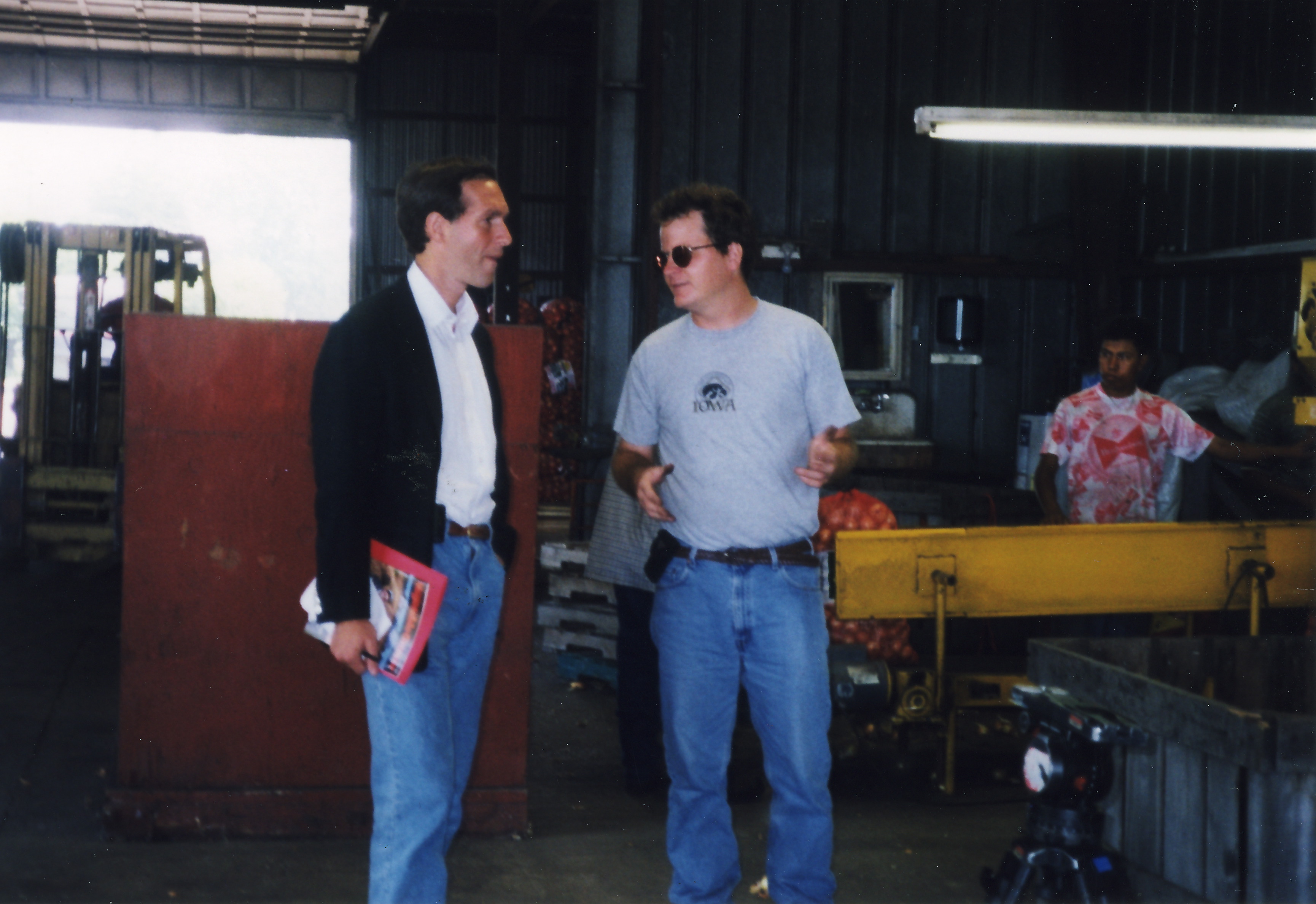
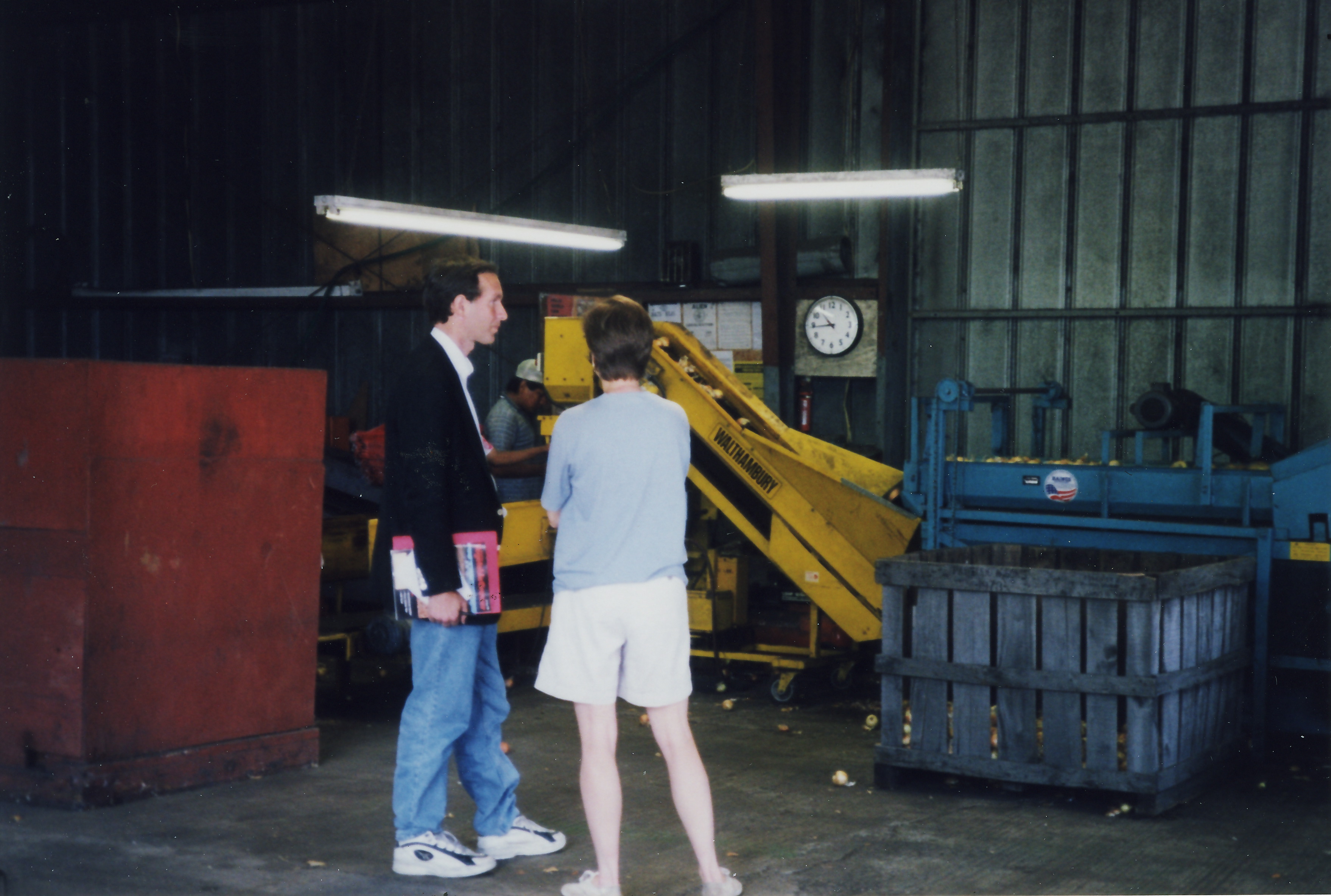
Shortly after this event took place, in mid May, we were once again contacted by CNN. They wanted to do a follow-up story to the previous 2 stories about the drought. It had somewhat lingered through the winter into the early spring. We were happy to be interviewed again and on May 16th, 2000, CNN reporter Maria Hinojosa along with her crew arrived to interview Eve and me. She too was extremely kind and friendly. I immediately mentioned that I used to listen to her on NPR and she was taken a bit aback. She asked, almost incredulously, “you’re a farmer … you listen to NPR.” I laughed and replied that indeed I did, and rattled off a number of show, “All Things Considered,” “Morning Edition,” “Talk of the Nation,” etc … and named a number of other public radio reporters and personalities. She was a bit in shock. I remember telling her I enjoyed Ray Suarez on “Talk of the Nation.” Suarez had just left, to go to be a correspondent for the “NewsHour with Jim Lehrer,” and that he seemed a bit uncomfortable in front of the camera (he does quite well now).

The interview focused on the continuing drought and once again highlighted we personally lost $150,000 the previous season. I stated:

“We’ve had some decent rains recently and things are going well now, but if the spigot is shut off, like it was last year, we’re going to be in a load of trouble.” 

The irony was that 2000 turned out being an excessively wet season. There was no specific storm or event, but it was exactly opposite of what happened the previous season. The excessively wet season caused an excessive amount of decay or waste with that season’s onion crop, and we once again took a devastating financial beating. That meant 4 out of 5 seasons were terrible years for the majority of growers in the Black Dirt.

One last humorous anecdote about the Hinojosa interview, after she and her crew departed, about a half hour later she called me on her cell and she asked:

I was wearing open toed shoes … do I have to worry about ticks and lyme disease since my feet were exposed?”

I replied:

Oh, you don’t have to worry about that Maria, with the crap I spray you don’t have to worry about any ticks.”

You could almost see the blood drain from her face over the phone. I then laughed and said I was only joking, we hadn’t sprayed any insecticides yet and she was perfectly safe in the field. Heck, our 4 year old son Caleb was playing in that dirt (and a shot of that appeared in the news piece.) She laughed and was doubly relieved.

Yes, I’m a jerk, but I couldn’t help myself.

The story aired on May 16st  and May 17th  2000. It was another example of how the federal crop insurance program was deeply flawed. We used it, and the previous pieces, to make our case to improve the policy and to secure additional disaster aid. On July 6th, 2000 we helped organize with Cornell Cooperative Extension  a legislative tour of farms in Orange County. Representative. Gilman attended and we hit him hard in regards the need for disaster aid.

And as the rains continued to fall in 2000 it became evident that we were going to need a special supplemental disaster aid package. From this point on, Eve and I increased our efforts in regards to both goals. I can’t even accurately relate over the years, and especially from 1999 onward, how many phone calls, e-mails, faxes, posting on the internet, Eve and I did. Once, when Eve intended to call her parents in South Carolina she accidentally instead called Congressman Gilman’s Washington, DC number. And when Gilman’s Legislative Director Todd Burger answered she quickly realized her mistake and apologized to Todd. But since he was on the phone she quickly segued and said, “well, since you’re on the phone can you give me an update on the latest regarding the disaster aid?”

The backstory on our first two CNN appearances

The following is another brief excerpt from my yet unpublished memoir, “Muckville: Farm Policy, Media and the Strange Oddities of Semi-Rural Life.” It deals with the backstory involving Eve and I’s first two CNN appearances.

Image

As the 1999 growing season progressed a devastating drought began to slowly affect the eastern seaboard. By mid-August the effects and toll taken on all sorts of crops began to become evident. In late August Eve and I were contacted by CNN. I got a call from producer Frances Causey. She had come across some of my materials regarding crop insurance and asked if we would mind being interviewed for a story about the drought and the problems with crop insurance. We happily agreed. I sent Frances a ton of information, and then we spoke a bit about Ken Ackerman. I related all that had happened in our meetings with Glickman, how Glickman and his operatives knew how poor the onion policy was, and how the buy-up policy in particular was essentially a rip-off. And how USDA officials, and Ackerman in particular, would continue to state untrue things like “CAT was free” and the onion farmers of Orange County were in a situation that was their own fault, because the failed purchase the buy-up. This was despite Glickman saying this sort of thing would stop. I also told her what happened with American Vegetable Grower and how USDA put pressure on the magazine to pull the USDA official’s offending quote.

(Note: Frances Causey is the Producer and Co-Director of the fantastic documentary “Heist: Who Stole The American Dream.” http://www.heist-themovie.com/theTeam.html)

She told me that CNN planned on interviewing Ackerman as they interviewed Eve and I for the story. I told Causey that Ackerman and the USDA would certainly try to pull the same sort of stunt that they did with American Vegetable Grower a year before.

ImageImageImage

On August 17th, 1999, veteran CNN correspondent Gary Tuchman and crew came to our farm to interview us. Like Randall Pinkston of CBS Tuchman was very friendly and kind. They spent much of the day interviewing Maire Ullrich, the vegetable crop agent at the time for Cornell cooperative Extension, Eve and me. The piece was outstanding (it had one small error, it stated I had CAT coverage at the time but in 1999 we actually had the buy-up, despite how bad it was.) It was a pretty devastating indictment of the current crop insurance program. Ackerman was interviewed separately in Washington by a stringer crew. And Ackerman, predictably, placed the blame everywhere but himself and the Agency. The piece reported:

“’Our program is often very bureaucratic,’ said Ken Ackerman of the department. We have a number of legal restraints that make it difficult for us to respond to situations.” Tuchman then states. ‘But Ken Ackerman says that the current system of taxpayer-supported crop insurance, for which farmers pay just a small fee, often should be supplemented with so-called ‘buy up’ policies for extra coverage.”

So, once again Ackerman attempted to mislead the press and public regarding the true cost or value of CAT and wrongly blame the farmers for their current predicament. Though very pleased with the piece, which ran the evening of August 17,1999 and also multiple times on CNN’s Headline News channel, I was very angry about Ackerman’s quotes and implied blame. After the piece aired I spoke with Butch May at USDA and told him to tell Ackerman that “I thought his mommy dressed him very nice for his TV interview.”

ImageImageImageImage

You may wonder, even though it held such little value, why on earth did we buy the buy-up policy for the 1999 growing season? Because of Eve and my view that we did have a responsibility to assist in managing our risk. So, though a waste of money, we felt that the position of having bought it strengthened our ability to work within

the framework of the system to fix the policy. We figured, it would be kind of hard to argue for a “No Stages” program if we didn’t actively participate within the system. So, we bit the bullet and bought it. And to this day we believe it was a factor in motivating Grau to put so much pressure on RMA/FCIC and the various bureaucrats to get us that pilot and listen to our concerns. Of course Congressman Gilman putting incessant pressure on them helped.

As the summer progressed into autumn it quickly began to sink in how bad the losses from the drought were and how little even our buy-up policies were going to help. In early October, CNN producer Frances Causey called us and asked how things were going. We told her the drought was worse than even we thought it would be and the year was going to be a real body blow. She asked if they could interview us for a rare follow-up story and we happily agreed. She also said that this time she would be coming out with reporter Gary Tuchman and crew.

Causey, Tuchman and crew arrived on October 14th  to shoot the 2nd story. Once again Tuchman was very kind, matched only by the warmth expressed by Causey. As we re-capped what had developed since their first story Frances, while laughing, detailed what happened with the Ken Ackerman interview. She was simply amazed that Ackerman and USDA did exactly what I predicted they would do, how he would imply CAT was free and the farmers were at fault for not buying the virtually worthless buy-up (we told Frances the one small error in the piece was that we did in fact have the buy-up insurance for the 1999 crop year but inexplicably they reported again that we only had CAT) and she confirmed that Ackerman and USDA were very displeased with the portions involving him in the August piece. “Ackerman and the USDA implied we took him out of context but look at this,” she then pulled out a document from her bag and continued, “this is the word for word transcript of his interview. He didn’t say what he said just once, he kept repeating it over and over again.” What a surprise … not.

The 2nd  piece aired all day on October 15th  and it too packed an incredible punch.

It was at this point that Eve and I kicked it into high gear in regards to not only fighting for changes to the crop insurance program but also for a special disaster aid program for the onion growers of Orange County. This was now the third devastating year out of four and we needed some sort of special assistance to continue to survive as an industry in our region. When we first started raising the possibility of such aid in 1998 we were told by Representative Gilman’s press secretary that it was an “unrealistic request.”

But when you are wiped out three out of four years you don’t accept such a rejection. In 1999 President Clinton signed a $1.4 billion ad-hoc disaster aid package passed by Congress. The structure and formulation of that ad- hoc disaster aid program was based on the very same federal crop insurance program which made necessary that aid package to begin with. Well, we knew we would need more targeted help. In the October 1999 CNN piece Tuchman reported our assessment that the aid package would only provide us with pennies on the dollar on our losses. And when it was eventually appropriated we learned that we were correct.