This post is for all of my new Twitter and blog followers (sorry for the repetition to my longtime followers).
Back in the winter I wrote a book about my wonderful wife Eve’s life on the farm and our media and public policy work. The title of the book is:
“Muckville: Farm Policy, Media and the Strange Oddities of Semi-Rural Life”
I have an editor but I am looking for a publisher. It’s an odd sort of book that doesn’t fit neatly in any real sort of category. It’s about farming and the strange stuff we deal with but mainly about our struggles in dealing with government and trying to change things from the ground level.
This link covers some of that policy work:
http://digital.turn-page.com/i/102943/3
If you happen to know anyone that might be interested in such a work please feel free to pass my info along. I will give you lots and lots of onions!
Below is prologue and a word from Eve:
PROLOGUE
Muckville. I can see you asking yourself now
Why should I care about a book about farming? Or one about public policy advocacy and dealing with the media? Or a about a book that combines the realities of farming with agriculture-specific policy, advocacy and dealing with the media?
We all have to eat. Every day if possible. Day after day. Until we die we have to eat. Food, along with breathable air, clean water and adequate shelter is one of our most basic needs. Since there are roughly 3.3 million farmers in the U.S. comprising roughly 2% of the general population, odds are you have never met a farmer. Despite the growth in popularity of Community Supported Agriculture (CSA) and local farmers’ markets it is most likely you have never met, spoken, smelled or touched a farmer. Or set foot on a farm.
Though the United States was once a primarily an agricultural society and even as recently as the turn of the previous century roughly 40% of the population farmed, since then, and especially since the advancements associated with Norman Borlaug’s “Green Revolution” fewer and fewer farmers on less and less land space have produced one of the world’s safest, most abundant and cheapest food supplies.
And with that change has come an incredible level of disconnect between the people who primarily produce our food and the citizens who eat it. Sadly, when you mention the word farmer the first image that will pop into someone’s head will be Eddie Albert’s character Oliver Wendell Douglas from the CBS sitcom “Green Acres.” Or worse, some character from one of the various reality TV shows that keep popping up, and frequently aren’t so real.
Though farmers’ markets are exploding across the country and thanks to the foodie movement there is a strong renewed interest in agriculture, much of the information about farmers is not coming from us. Food critics and chefs will frequently pontificate about farming, and though some of them may have a small hobby farm, for the most part they are not farmers. They do not know what it is like, on a day to day basis, to be a farmer in the 21st century.
I simply don’t have enough heads for all the hats I have to wear. I have to be a soil scientist, a chemist, a financial planner, an accountant, a bookkeeper, a regulator, a marketer and frequently a public relations person and public policy advocate.
Farming today is governed by a myriad of laws and regulations that cover numerous aspects of our business on multiple levels. And there are so many groups, organizations and pressures out there trying to influence or change those laws and regulations on a seemingly daily basis.
In the mid 1990’s after leaving the farm a short time to pursue my graduate degree and after I married my wonderful wife Eve, I returned to the family onion farm. My brother and I are the fourth generation of the same family on a farm that started in the U.S. at the turn of the 20th century. As soon as I returned I started dealing with a variety of issues and crises, including weather disasters and various labor advocacy organizations. I was baptized by fire. Eve and I had to learn, for the most part on our own, how to fight for our farm and our industry. It wasn’t easy at first (for the most part it still isn’t now, 17 years later). But, trial by fire typically isn’t.
So why is this all important to you? Because as I said, we all have to eat. It’s one of our most fundamental needs. You should know something about how your food is produced. Not from sitcoms, or from food critics or from chefs, no matter how well intentioned they may be. You should know from one of us who produces it.
Now, there are some books out there written by farmers about farming. Many of those books are about the adventures of people who eschew urban or suburban life to move to the country and take up farming. They extol the benefits of a more simple life.
That’s not the point of this book.
Life is not simple, nor, quite frequently, very fair. A hailstorm that decimates your crop mid season or a hurricane caused flood that wipes virtually your entire crop away is not fair. And how you deal with those scenarios is anything but simple. I’ve dealt with those situations, sadly, more than once. I’ve also dealt with very stupid government programs and terrible proposed legislation. And over the years my wife and I have had a fair number of successes in dealing with such situations. That’s what this book details.
Though it is a memoir about my specific experiences on the farm and in front of a camera or on Capitol Hill, what I relate, the techniques and the tricks and methods of dealing with the media or developing grassroot strategies to fight for a given issue can be applied by you. No matter what you do, or where you live, or what problem you may be facing, my example can provide you with a roadmap to how you can successfully fight for your cause.
The system is messed up. It sucks, to be quite frank. But my specific experiences show that if you are persistent and you have a fraction of a clue as to what to do, you can make a positive change for your community, too.
Why should you read this book? Because I need better informed end users of my product. I need you to understand why after a devastating hailstorm or flood I need your support and help. I need you to have a better connection with the people who produce the food you eat. And, you need to better understand the people who grow your food, and how the policy decisions can affect every aspect of the food you eat.
Why should you read this book? Just as important as learning about how your food is grown, I want you to read it and to realize that you can get off the couch and fight for your family and your community. Though the deck is stacked against you, like it is against me, you can still effect a positive change. All is not bleak. There is hope.
I want you to read this book so that the next time you walk into the produce section of your local supermarket you will pause for a moment and just think about what was involved to get those fresh vegetables and fruits on that shelf.
A NOTE FROM EVE
Muckville. That’s where we live, both literally and figuratively.
And every day something weird is happening on this farm. In the early years I kept waiting for it to end, waiting for calm. After 20 years I now realize that for better or worse, that’s just not going to happen. Part of it has to do with who I married. I think he described it best one night when we were talking about how people react to adversity. He said, “People basically fall into one of two categories: sheep or wolf. And I’m not a sheep.” I think I am a sheep who hitched a ride with a wolf. When we lost our crop to hail the first time in 1996 and our insurance turned out to be worthless and I was pregnant and large amounts of debt loomed on the horizon, I was perfectly willing to throw up my hands, quit and go do something else. In that respect I think I am like most people. Life is just easier if you can go along with the flow and avoid the pitfalls. But if everyone did that improvements would seldom if ever be made.
If I’ve surmised anything over the years, it’s that problems come about seemingly on their own resulting from a convergence of factors: a misinterpretation of a law or regulation, a quirky personality, a do-gooder who is just plain wrong, and/or a bureaucrat who refuses to do anything other than “the way it’s always been done.” The result is that change takes a lot of work but more importantly perseverance.
So what do you need to make a change? The first quality just about everyone has. It equates to “What the @#$% happened here?” The second quality many people have, “I’m mad. I’m going to complain to the proper authorities, and this will be fixed!” But there are a lot of problems out there and it is just as likely that your problem won’t be fixed. Sure some may complain for a while but at some point most people simply cut their losses and walk away grumbling. If you are really determined to make a change, it takes more than complaining. Change comes about because you can articulate exactly what is wrong and why, AND you have mapped out and researched what should be done instead. Only then do you have a chance.
Chris (God bless him) has chronicled several things we have fought to change. Some of it is humorous. a lot of it comes under “You just can’t make that up!” and parts of it I simply cannot read because it was enough for me to live through it. We hope that you will be entertained and learn a little about production agriculture along the way. But what we really hope is that maybe the next time you see a problem, you will have the courage to be a wolf.


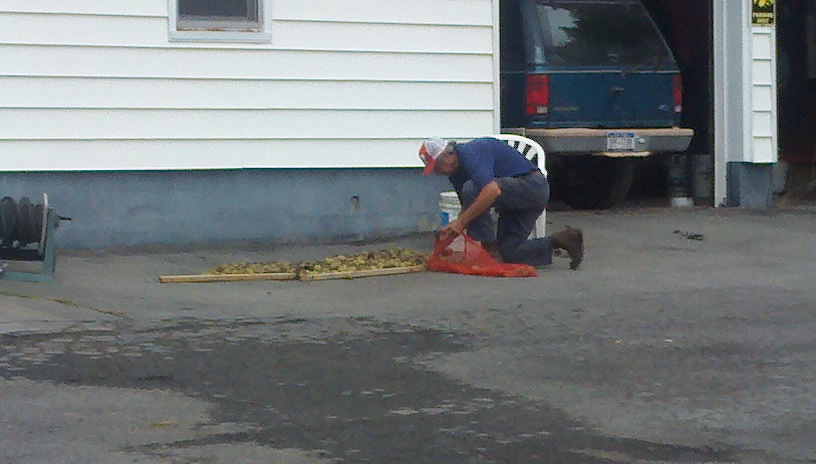
 Mucking it up in Muckville